
Quick answer
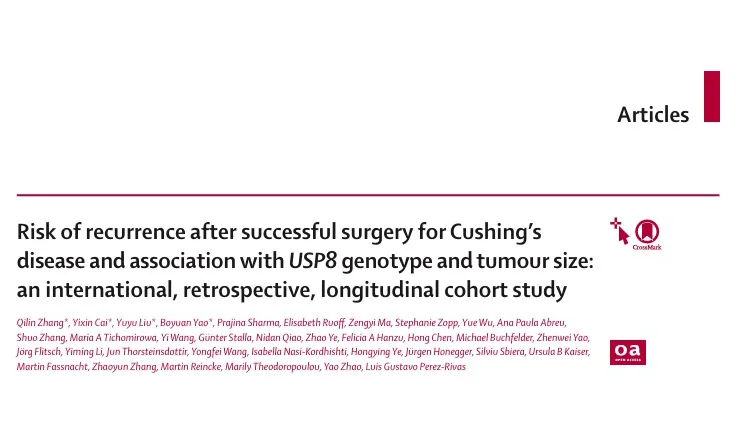
Cushing's disease — a pituitary adenoma secreting adrenocorticotropic hormone — can be cured by surgery, and after a successful operation patients are monitored for years because recurrence is common and hard to predict. Zhao Yao and the Golden Pituitary team at Huashan Hospital led eight international centres to build the largest cohort yet assembled for this question: 435 patients with long follow-up, tumour USP8 genotype and tumour size. Combined, the two variables sort patients into three recurrence-risk tiers, published in The Lancet Diabetes & Endocrinology on 2 March 2026 [1][2][4].
Key takeaways
- Design: international, retrospective, longitudinal cohort across eight high-level centres [2][4].
- Partners include Munich University Hospital and Harvard's Brigham and Women's Hospital [2].
- 435 patients with surgically remitted Cushing's disease and available tumour genotype [6].
- USP8 wild-type macroadenomas had a ten-year recurrence rate of about 44.5% [3].
- In USP8-mutant tumours, recurrence risk was independent of tumour size [3].
Why genotype adds something size does not
USP8 mutations are the commonest genetic alteration in corticotroph adenomas and were discovered in 2015 by Chinese and German groups working together. What the new cohort shows is that the mutation carries prognostic meaning: USP8-mutant tumours behave similarly whether they are microadenomas or macroadenomas, so size alone misclassifies them, while USP8 wild-type tumours do get riskier as they get larger [3][5].
Clinically that translates into a three-tier framework: a genuinely low-risk group who can be followed less intensively, and a high-risk group who need longer and closer surveillance so that recurrence is caught early rather than at the point of symptoms [2][3].
What the study can and cannot claim
This is the largest genotype–phenotype analysis in Cushing's disease to date, and the journal invited an independent commentary describing it that way. The practical proposal is that USP8 genotyping should enter routine post-operative practice [2][4].
The cohort was assembled retrospectively across centres with different surgical techniques, follow-up protocols and assay methods, and genotype was available only for patients whose tumour tissue had been tested — which may not be a random subset. Recurrence risk models built this way need prospective validation before they change surveillance guidelines. There is also a practical barrier: USP8 testing requires tumour tissue and a molecular pathology service, which most pituitary centres do not have [4][5].
The condition in context: Cushing's disease
Cushing's disease causes hypertension, diabetes, osteoporosis, infection and psychiatric illness, and untreated it is lethal.
| Region | What the data shows | Source |
|---|---|---|
| Treatment | Transsphenoidal surgery is first-line and can achieve remission [2]. | Fudan alumni report [2] |
| Recurrence | Recurrence after remission is common and previously unpredictable [3]. | Tencent News [3] |
| Follow-up burden | Uniform intensive surveillance imposes cost and anxiety on low-risk patients [3]. | Tencent News [3] |
Because recurrence can appear a decade later, a marker available at the time of surgery has more practical value than one that requires waiting [3][5].
Why it matters
| Potential | What the report suggests | Source |
|---|---|---|
| Risk stratification | A three-tier model from genotype and size [2][3]. | [2][3] |
| Less burden | Low-risk patients could be followed less often [3]. | [3] |
| Caution | Retrospective; needs prospective validation [4]. | [4] |
Availability and limits
- This is an editorial summary of the publication, not a treatment recommendation [1][2].
- USP8 testing requires tumour tissue and a molecular pathology service [5].
- The model is prognostic, not a guide to reoperation or radiotherapy [3].
- Cohort heterogeneity across eight centres limits precision [4].
- Follow-up schedules remain a local clinical decision [2].
What to ask before booking
| Question | Why it matters |
|---|---|
| Will my tumour tissue be tested for USP8? | It determines which risk tier applies [3]. |
| How long will I be followed after remission? | Recurrence can occur a decade later [4]. |
| Which department handles foreign patients, and in what language? | Huashan is a working hospital we do not book; confirm international-department coordination and language support. |
| What tests define remission and recurrence here? | Assays differ between centres [2]. |
Questions patients ask
What did the study find?
USP8 genotype combined with tumour size predicts recurrence risk after surgically remitted Cushing's disease, forming a three-tier framework [2][3].
How many patients?
435, across eight international high-level centres, with long follow-up [6].
What is the recurrence rate?
USP8 wild-type macroadenomas had a ten-year recurrence rate of about 44.5%; USP8-mutant tumours recurred independently of size [3].
Where was it published?
The Lancet Diabetes & Endocrinology, online 2 March 2026 [1][2].
Is this relevant to international patients?
It is useful context for pituitary centres. Huashan is a working hospital we do not book — contact its international department directly [1].