
Quick answer
Primary CNS lymphoma of the large B-cell type (PCNS-LBCL) is one of the worst-prognosis lymphomas, partly because most drugs cannot cross the blood-brain barrier well. A Huashan Hospital team led by Chen Tong and Mao Ying added the brain-penetrant BTK inhibitor orelabrutinib to a standard rituximab–methotrexate backbone. The resulting ORMD regimen produced deeper responses and longer progression-free and overall survival than RMD alone, with acceptable toxicity [1][2][3]. The regimen is being studied in a registered trial (NCT07185373) [4].
Key takeaways
- ORMD = orelabrutinib + teniposide + rituximab + methotrexate; comparator was standard RMD [1].
- Patients were newly diagnosed with PCNS-LBCL [1].
- The orelabrutinib arm had significantly higher response rates and longer PFS and median OS [2].
- Mechanistically, MyD88 L265P stabilises PIM1; orelabrutinib degrades PIM1 and induces apoptosis [1][2].
- Cerebrospinal fluid ctDNA tracked response, supporting its use for monitoring [1].
The problem
PCNS-LBCL arises in the brain, so surgery is rarely curative and chemotherapy must penetrate the blood-brain barrier. High-dose methotrexate is the backbone, but many patients relapse, and outcomes remain poor compared with systemic diffuse large B-cell lymphoma. Drugs that reach the brain are therefore the obvious candidates for addition [1][3].
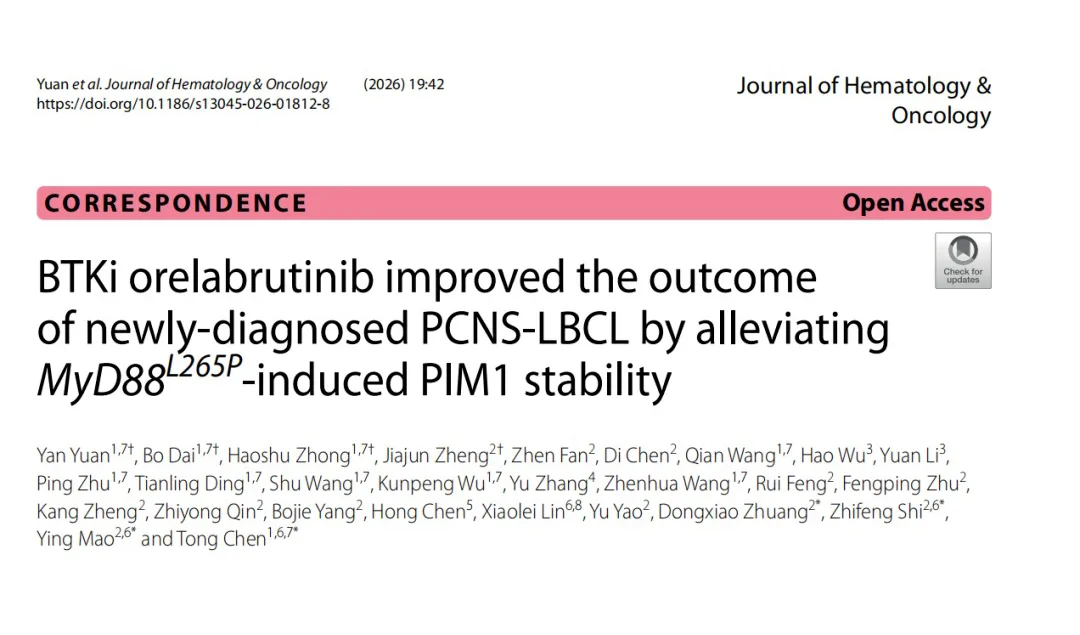
Orelabrutinib is a covalent BTK inhibitor designed for better CNS penetration than earlier compounds. The team also explored why it might work in this disease specifically: tumours carrying the MyD88 L265P mutation show raised PIM1, a kinase that supports survival, and orelabrutinib appears to reduce PIM1 stability — a mechanism beyond simple BTK blockade [1][2][5]. The work drew on haematology, neurosurgery, radiology, ophthalmology and pathology — a combination that reflects how CNS lymphoma is actually diagnosed and treated [3].
What the study found
Compared with RMD, the four-drug ORMD regimen produced higher complete and overall response rates, longer progression-free survival and a longer median overall survival, while remaining tolerable. The paper also reports that cerebrospinal fluid ctDNA reflected tumour response, which matters because imaging in the brain is slow to change and cannot easily be repeated [1][2].
The design is a comparison with a historical or concurrent standard arm rather than a large randomised trial, and the sample is single-centre. ORMD adds a fourth drug and cost, and longer follow-up is needed to see whether the survival gain persists. Independent replication and randomised confirmation would be required before it becomes a standard [2][3].
The condition in context: primary CNS lymphoma
It is rare but disproportionately lethal, and treatment options are constrained by anatomy.
| Region | What the data shows | Source |
|---|---|---|
| Prognosis | PCNS-LBCL is among the worst-prognosis extranodal large B-cell lymphomas [3]. | PharmCube [3] |
| Treatment | High-dose methotrexate-based regimens are standard, with high relapse rates [1]. | Huashan [1] |
| China | Huashan is one of the country's main CNS lymphoma referral centres [3]. | PharmCube [3] |
Because the disease is rare, single-centre series with biologically plausible mechanisms often drive progress before large trials exist [2].
Why it matters
| Potential | What the report suggests | Source |
|---|---|---|
| Efficacy | Higher response rates and longer PFS and OS with ORMD [2]. | [2] |
| Monitoring | CSF ctDNA may track response better than imaging [1]. | [1] |
| Caution | Single-centre comparison; randomised confirmation needed [3]. | [3] |
Availability and limits
- This is an editorial summary of the publication and reports, not a treatment recommendation [1][2].
- The comparison is not a large multicentre randomised trial [3].
- BTK inhibitors carry bleeding, infection and arrhythmia risks [2].
- CSF ctDNA testing is not universally available [1].
- Long-term survival data are still maturing [2].
What to ask before booking
| Question | Why it matters |
|---|---|
| Is my tumour MyD88-mutant? | The mechanism described is specific to that genotype [1]. |
| Is orelabrutinib available and reimbursed for this indication? | Approval status varies by indication [3]. |
| Which department handles foreign patients, and in what language? | Huashan is a working hospital we do not book; confirm international-department coordination and language support. |
| How will response be monitored? | Imaging plus CSF ctDNA may be used [1]. |
Questions patients ask
What is ORMD?
Orelabrutinib plus teniposide, rituximab and methotrexate — a four-drug first-line regimen for primary CNS large B-cell lymphoma [1].
What did the study show?
Compared with standard RMD, ORMD produced higher response rates and longer progression-free and overall survival, with acceptable tolerability [1][2].
How does orelabrutinib work here?
Beyond BTK inhibition, it appears to reduce PIM1 stability driven by the MyD88 L265P mutation, promoting tumour cell apoptosis [1][2].
Where was it published?
Journal of Hematology & Oncology, online 17 June 2026 [1][3].
Is this relevant to international patients?
It is useful context for China's CNS lymphoma care. Huashan is a working hospital we do not book — contact its international department directly [1].