
Quick answer
In China the implant itself now costs about $1,000 (7,000 yuan), down from an average of 35,000 before the 2021 national procurement — an 82% cut [1]. The rest of the episode (surgery, anaesthesia, ward, rehabilitation) is set province by province, so there is no single national total, but patients in reported cases describe paying under $1,430 (10,000 yuan) for the whole operation [4]. In the United States the same operation carries a list price of $32,000–75,000, a Medicare payment of about $14,000, and a median cash price across 311 hospitals of $21,456 — three numbers, none of them what most patients actually pay [6].
Key takeaways
- China's 2021 hip implant procurement cut the average price from $5,000 to about $1,000 (35,000 to $1,000 (7,000 yuan)); the 2024 renewal round cut it a further 6% [1][2].
- More than 1.1 million procured implants were used in the first two years, benefiting over 500,000 patients a year [2].
- Annual demand in the renewal round was 286,000 hips — a volume no European country approaches [2].
- US pricing is a three-tier system: chargemaster, Medicare, cash. Only one of them is a real price [6].
- A hip replacement is a two-to-three-week trip, not a two-visit procedure: surgery, then inpatient rehabilitation before you fly.
First, define the episode
An implant is not an operation. The price you are quoted can cover any of the following.
| Scope | What is included | Who quotes it |
|---|---|---|
| Implant only | The prosthesis | Procurement documents, device companies |
| Surgical episode | Implant, surgery, anaesthesia, ward, standard rehabilitation | Hospitals, most patients |
| Full pathway | Episode plus pre-op workup, blood, imaging, physiotherapy after discharge | Insurers, international departments |
Everything below is the surgical episode unless stated otherwise.
China: the implant fell by 82%
The national joint procurement opened in Tianjin in September 2021, covering primary hip and knee replacements. Intentional volume was 540,000 sets in the first year, about 90% of national demand [1].
| Item | Before | After |
|---|---|---|
| Hip implant, average | $5,000 (35,000 yuan) | About $1,000 (7,000 yuan) |
| Knee implant, average | $4,570 (32,000 yuan) | About $715 (5,000 yuan) |
| Overall reduction | — | 82% [1] |
| Ceramic-on-ceramic hips | — | −77.4% [3] |
| Ceramic-on-polyethylene hips | — | −80.4% [3] |
| Metal-on-polyethylene hips | — | −82.9% [3] |
The renewal round in May 2024 trimmed prices a further 6% and set annual demand at 286,000 hips and 260,000 knees; by then more than 1.1 million procured joints had been used, benefiting over 500,000 patients a year [2].
What about the rest of the bill? Surgical fees, anaesthesia, ward days and rehabilitation are set at provincial level, so a hospital in Shanghai and one in Chengdu do not charge the same. We could not verify a single national total, and we will not invent one. What can be said is that with the implant at about $1,000 (7,000 yuan), the device is no longer the dominant line item — and one patient reported in People's Daily described his knee replacement falling to under $1,430 (10,000 yuan) in total after procurement [4].
The United States: one operation, three prices
| Price | Amount | What it means |
|---|---|---|
| Chargemaster (list) | $32,000–75,000 | Published by the hospital; almost nobody pays it [6] |
| Medicare | About $14,000 | What the public payer allows for facility plus surgeon [6] |
| Cash price, median of 311 hospitals | $21,456 | What a self-paying patient is quoted [6] |
| Insured patient, typical | $2,000–5,000 | Deductible and co-insurance, not the price [6] |
This is why American comparisons are so unreliable. A clinic that advertises “$40,000” may be quoting the chargemaster; a patient who says “it cost me $3,000” is describing their deductible. Neither is the price of the operation.
The comparison
| Country | Surgical episode, one hip | In yuan | How the price is set |
|---|---|---|---|
| China (public) | Implant ~$1,000 (7,000 yuan); ward and surgery set provincially | Typically under $2,860 for the episode [1][4] | National implant procurement plus provincial fees |
| Turkey | $5,000–8,000 | 36,000–57,000 | Private hospital market, often packaged |
| United Kingdom | £12,000–15,000 private | 110,000–137,000 | NHS free with waiting lists; private priced separately [5] |
| Germany | €10,000–15,000 | 77,000–115,000 | Statutory diagnosis-related groups; private fee schedule |
| United States | $21,456 median cash; $14,000 Medicare | 98,000–150,000 | Chargemaster, Medicare and cash are three different prices [6] |
| Australia | A$25,000–35,000 private | 118,000–165,000 | Public free with waiting lists; private case by case |
Non-Chinese figures are indicative, compiled from published price lists and transparency data in 2026, and should be read as orders of magnitude rather than quotes.
Where the gap comes from
| Factor | Effect |
|---|---|
| Implant procurement | One national buyer instead of thousands of hospitals [1] |
| Ward and rehab days | Shorter average stays in China reduce the episode cost |
| Payment model | US chargemaster pricing has no relationship to cost [6] |
| Liability and overhead | Priced into private fees in the US, UK and Australia |
Five things the price does not tell you
- Bearing surface. Ceramic-on-ceramic, ceramic-on-polyethylene and metal-on-polyethylene behave differently over 15–20 years, and the price gap between them survives procurement [3].
- Fixation. Cemented and cementless stems suit different bone quality. Ask which and why.
- Surgeon volume. As with any technically demanding operation, volume and outcome are linked. Ask how many this surgeon does a year, not how many the hospital does [2].
- Revision. A revision costs more than a primary and is more likely in younger, active patients. Ask what the clinic charges for one.
- Clot prevention and rehab. Anticoagulation and physiotherapy protocols decide much of the outcome, and are billed separately in some systems.
Two to three weeks, not two visits
Unlike a cataract operation, a hip replacement is not something you fly home from in four days. The practical pattern is: arrive, pre-operative workup, surgery, three to seven days in hospital, then one to two weeks of supervised rehabilitation before the flight home. Most patients fly at around two to three weeks, with a clot-prevention plan and a fit-to-fly assessment.
That changes the cost arithmetic. Add two to three weeks of accommodation, a companion, and lost work to the surgical fee. For a procedure priced at $2,140 (15,000 yuan), the travel can exceed the treatment.
City by city inside China
The implant price is national. Almost everything else is not.
1. Provincial fee schedules. Surgical fees, ward charges and rehabilitation are set at provincial level, so the same operation costs different amounts in different provinces even after procurement.
2. Waiting time. High-volume joint centres book weeks ahead; some hospitals run dedicated joint-replacement wards with shorter waits.
3. Rehabilitation capacity. The limiting factor for a foreign patient is often not the surgery but where to do two weeks of physiotherapy afterwards.
| City | What tends to differ |
|---|---|
| Shanghai | High-volume joint centres; international departments with English service; highest private pricing |
| Beijing | National-level orthopaedic hospitals; longer queues at the best-known names |
| Guangzhou | Strong tertiary orthopaedics; shorter surgical waits, warmer climate for early mobilisation |
| Chengdu | Lower cost base; large referral hospitals for western China |
| Hangzhou | Provincial pricing; good rehabilitation facilities, less congestion |
Ask each hospital for its own all-in figure for the episode, including ward days and rehabilitation, and check which provincial schedule applies. A Shanghai international department and a Chengdu public ward are not comparable products.
The condition in context: what decides a good result
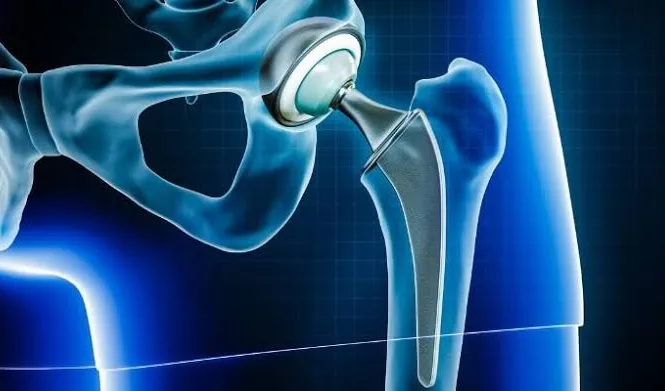
A hip replacement replaces the ball and socket with a metal or ceramic head and a cup, fixed either with cement or by encouraging bone to grow into the surface. The operation is routine; the outcome is decided by three things that are not the price.
Bone quality and fixation. Cemented stems suit older, osteoporotic bone; cementless stems rely on biological fixation in younger patients. Choosing wrongly raises the revision risk, not the bill.
Bearing surface. Ceramic-on-ceramic, ceramic-on-polyethylene and metal-on-polyethylene wear differently over 15 to 20 years. After procurement the price differences narrowed but the clinical differences did not [3].
Rehabilitation in the first six weeks. Clot prevention, early mobilisation and supervised physiotherapy determine how much function returns. A cheap operation with no rehabilitation plan is not cheap.
When not to travel for a hip replacement
| Situation | Why |
|---|---|
| Recent fracture needing urgent surgery | Timing matters; a flight is not a treatment |
| Significant heart or lung disease | Anaesthetic risk rises; continuity of care matters more than price |
| No rehabilitation arranged at home | The first six weeks determine much of the functional result |
| Complex revision or infected joint | Requires a specialist centre and long follow-up |
| You cannot stay two to three weeks | Flying early raises clot risk |
Decision checklist
| Question | If yes |
|---|---|
| Do I know the implant brand and bearing surface being quoted? | Comparable |
| Does the quote include ward days and rehabilitation? | Episode pricing |
| Can I stay two to three weeks? | Workable |
| Do I have physiotherapy arranged at home? | Essential |
| Does the saving exceed travel plus lost income? | Financially rational |
Availability and limits
- Chinese implant prices come from national procurement documents [1][2][3].
- We could not verify a single national total for the full episode; provincial fees vary.
- US figures come from published transparency and Medicare data, not from a single hospital [6].
- Outcomes depend on bone quality, fixation choice, surgeon volume and rehabilitation.
- We are not a provider and do not book treatment.
What to ask before booking
| Question | Why it matters |
|---|---|
| Which implant system, and is it the procured version? | Determines whether the 7,000-yuan price applies [1]. |
| How many days in hospital, and is rehabilitation included? | The largest variable after the implant. |
| Which department handles foreign patients, and in what language? | We do not book treatment; confirm the international department and its language support. |
| Who supervises physiotherapy after I fly home? | The first six weeks shape the result. |
| What does a revision cost here? | Rare but expensive; know it in advance. |
Questions patients ask
How much is a hip replacement in China?
The implant averages about $1,000 (7,000 yuan) after the 2021 national procurement, down from 35,000. Surgery, ward and rehabilitation are set by province, so totals vary; reported cases describe the whole operation coming in under $1,430 (10,000 yuan) for insured patients, and foreign patients paying cash should ask each hospital for its all-in figure [1][4].
Why is the same operation $14,000 in one US number and $65,000 in another?
Because they are different prices. The chargemaster is a published list price, Medicare is what the public payer allows, and the cash price is what a self-paying patient is quoted. A median of 311 hospitals publishing cash prices was $21,456 [6].
How long do I need to stay in China?
Plan two to three weeks: workup, surgery, three to seven days inpatient, then one to two weeks of supervised rehabilitation before flying. A fit-to-fly assessment and clot-prevention plan should be part of the discharge.
Is a cheap implant worse?
Not automatically. The procured list includes mainstream domestic and international brands, and prices fell 77-83% depending on bearing surface. What matters is the bearing surface chosen, the fixation, and the surgeon's volume [3].
Which Chinese city is best for a hip replacement?
Shanghai, Beijing, Guangzhou, Chengdu and Hangzhou all have high-volume joint centres. What differs is provincial pricing, waiting time and rehabilitation capacity. Ask for the all-in episode price, not the implant price.