
Quick answer
A 42-year-old patient living in Sydney with twelve years of type 2 diabetes developed a rapidly spreading foot infection in June 2026. After three debridements and the loss of three toes at a local hospital, her vascular team concluded the foot was not salvageable and recommended a below-knee amputation. She searched for limb-salvage centres, called a hospital in Guangzhou, and was told there was still a chance. She flew roughly 7,500 km to Guangzhou Red Cross Hospital, arriving on 3 July. Four operations over 34 days later, the wound had closed and the limb was intact [1][2].
Key takeaways
- Patient: 42 years old, twelve-year history of type 2 diabetes, living in Sydney; she had not been monitoring glucose or screening for complications [4].
- Onset: 12 June 2026, with redness, swelling and a blackening third toe; severe infection with odour within two days [1].
- Overseas course: three debridements and amputation of the third to fifth toes, after which infection reached bone and the foot was declared non-salvageable [1][3].
- Transfer: about 18 hours from Sydney to a Guangzhou ward, arriving late on 3 July [1][5].
- Outcome: four operations, artificial dermis then a split-thickness graft, wound fully closed on 6 August; she is still in rehabilitation [1][4].
How the case unfolded
The account comes from the hospital's own published case report and from two Guangzhou newspapers that interviewed the treating team. The local hospital's discharge note is quoted in one of them. No cost, no pathology and no long-term follow-up have been published [1][2][3].
| When | What happened |
|---|---|
| 12 Jun 2026 | Left foot became red, swollen and burning; the third toe blackened; within two days there was severe infection with a foul odour [1]. |
| Late June | In Sydney: three surgical debridements and amputation of the third, fourth and fifth toes. Infection continued into bone, with Charcot deformity and a collapsed arch [1][3]. |
| Decision point | The local vascular team concluded the foot could not be saved and recommended below-knee amputation. The progress note records that she had said she would rather die than use the remaining limb [3]. |
| Search and call | She searched overnight for limb-salvage techniques, found the diabetic foot centre in Guangzhou, and called the international line. The doctor on duty asked for photographs and records before anything else [1]. |
| Remote review | The centre head convened a multidisciplinary review with two senior consultants. Their judgement: the infection was severe but a salvage attempt was still reasonable if she could be moved quickly [1]. |
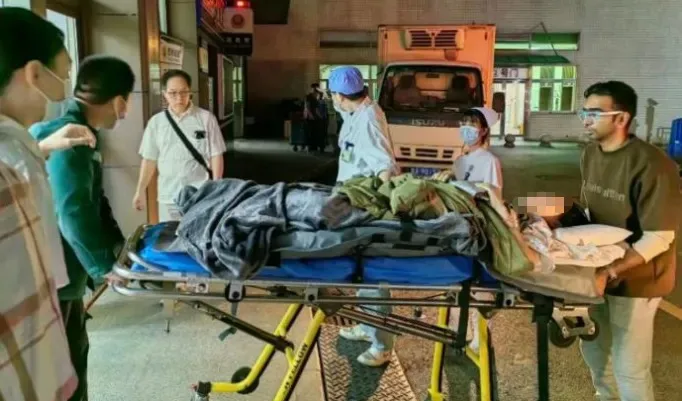
| 3 Jul 2026 | The transfer team reached the Sydney hospital at 06:00 local time. Flight to Hong Kong, then a cross-border ambulance to Guangzhou, arriving at 23:00 after about 18 hours [1][5]. |
| Night of arrival | Bilateral pneumonia, partial lung collapse and heart failure; unstable. The team spent the night on antibiotics, cardiac support and diuretics to create a window for surgery [1]. |
| During the stay | Emergency debridement for necrotising fasciitis with pus tracking into the calf; then artificial dermis, then a split-thickness skin graft from the thigh. Four operations in total [1]. |
| 6 Aug 2026 | At a dressing change the wound was fully closed, 34 days after admission. She remains in rehabilitation [1][4]. |
Why three toes were lost before the rescue started
The sequence in Sydney was not a mistake; it was the standard response to a foot that is already necrotic and infected. Debridement removes dead tissue to stop the spread, and toe amputation is often the price of controlling a source that has reached bone [1][3].
What changed in Guangzhou was the assessment of what remained. A foot with three toes gone, a collapsed arch and infection tracking through the deep compartments of the calf is not automatically unsalvageable; it depends on how much healthy skin, muscle and blood supply can be preserved after a complete debridement. That is a judgement about margins, not a single test [1][3].
What made the operation difficult
The hospital describes three problems stacked on top of each other:
- Necrotising fasciitis. Infection had spread from the foot into the deep muscle planes of the lower leg. The hospital puts mortality for this condition at up to 40%, and notes it had been developing for more than three weeks [1].
- A fragile patient. Twelve years of diabetes plus weeks of infection left her heart, lungs and kidneys compromised; she arrived with pneumonia and heart failure, and inflammatory and electrolyte values swung repeatedly. The hospital convened a hospital-wide review across more than ten specialties and set a three-step plan: control infection, repair the wound, rebuild function [1].
- Function, not just coverage. A closed wound over a destroyed arch is not a saved foot. Rehabilitation started while the graft was still healing, to limit muscle wasting before later reconstruction [1].
The condition in context: diabetic foot infection
Diabetic foot disease is a complication of long-standing, poorly controlled diabetes: nerve damage removes the warning pain of a small injury, reduced blood flow slows healing, and deformity changes where pressure falls. By the time the skin breaks down, infection can reach tendon and bone quickly [1][4].
| Question | What the reporting supports | Source |
|---|---|---|
| How fast can it progress? | In this case, from redness to severe infection in two days | [1] |
| Why amputate toes? | To remove a source of infection that has reached dead tissue and bone | [1][3] |
| Is amputation always the endpoint? | No; salvage depends on how much healthy tissue and blood supply remain | [1][3] |
| What is the warning sign? | Redness, swelling, blackening or odour in a diabetic foot needs same-day assessment | [4] |
What this case shows, and what it does not
It shows that a second opinion on operability can be worth a flight. The decision she was given was not wrong on its own terms; a different team, looking at the same foot with a different set of margins in mind, judged that enough tissue could be preserved, and then had the intensive-care capacity to get her through four operations [1][3].
It does not show that limb salvage is usually possible, or that travelling is safe. She arrived with pneumonia and heart failure after an 18-hour journey, which is exactly the risk a transfer like this carries; had she deteriorated in flight, the story would read differently [1].
It also does not show what the foot will do in two years. The wound closed; walking, sensation and the durability of the graft are still being tested in rehabilitation, and the hospital published no follow-up beyond that [1][4].
If you were this patient: what to arrange
- Send photographs and records before you book a flight. The first call was answered by a request for images and paperwork, not a promise [1].
- Ask what "salvageable" means in your case. How much skin, muscle and blood supply would remain after debridement is the question that decides the answer [1][3].
- Ask whether the receiving hospital can manage the intensive-care risk. She needed cardiac and respiratory support on the night of arrival, not just a surgical bed [1].
- Plan the transfer, not just the flight. This one ran through Hong Kong with a cross-border ambulance; a direct flight to a city with no receiving team achieves nothing [1][5].
- Check entry and payment before departure. China has no medical-visa category, and foreign patients are usually asked to pay in full and claim later [6].
Availability and limits
- This is an editorial summary of hospital and newspaper reporting, not a clinical record [1][2].
- The patient is identified only by a pseudonym; the hospital published photographs with her consent [1].
- No cost, no pathology and no follow-up beyond discharge-day wound closure have been published [1].
- The 40% mortality figure for necrotising fasciitis is the hospital's own statement, not a citation from a guideline [1].
- One successful salvage does not establish a success rate for the centre [1][2].
- Flying with an actively infected limb is dangerous; any transfer must be arranged with a receiving team [1].
What to ask before booking
| Question | Why it matters |
|---|---|
| What tissue would be left after a full debridement? | That margin, not the infection alone, decides salvage [1][3]. |
| Can you manage heart, lung and kidney support if I arrive unstable? | She needed it on night one [1]. |
| Which department handles foreign patients, and in what language? | The hospital is a working hospital we do not book; confirm international-department coordination and language support. |
| Who arranges the transfer, and by what route? | Flight, port of entry and ground ambulance have to be planned together [1][5]. |
| How many operations should I expect, and over how long? | Debridement, coverage and grafting are separate stages [1]. |
Questions patients ask
Was the amputation really avoidable?
The overseas team judged the foot non-salvageable. A second team in Guangzhou judged that enough healthy tissue could be preserved to attempt salvage, and the wound closed 34 days later. Both assessments were made on the same foot; they differed on margins [1][3].
How long was she in hospital?
34 days, from arrival late on 3 July to a fully closed wound at a dressing change on 6 August, across four operations [1].
How much did it cost?
No figure has been published. Foreign patients in China are generally asked to pay in full and claim from their insurer afterwards [6].
Can any patient do this?
The transfer itself is the risk: she arrived with pneumonia and heart failure after 18 hours of travel. Any move like this needs a receiving team and a plan agreed in advance [1].
What should a diabetic patient watch for?
Redness, swelling, blackening or odour in a foot needs same-day assessment. She had not been monitoring glucose or screening for complications before the infection started [4].