
Quick answer
Metabolic dysfunction-associated steatotic liver disease (MASLD) develops silently for years before it can be diagnosed. Using plasma proteomics and machine learning in a cohort of more than 50,000 people, a team led by Chen Hao and Sha Weihong at Guangdong Provincial People's Hospital [1][5] identified five plasma proteins that together predict MASLD up to 16 years before clinical diagnosis [1][2].
Key takeaways
- The model uses five proteins: FUOM, ACY1, KRT18, CDHR2 and GGT1 [2].
- It was built from a multinational, multicentre prospective cohort of more than 50,000 people [1].
- It stratifies risk up to 16 years before a clinical diagnosis, enabling earlier screening and intervention [1][2].
- Published online on 30 July 2026 in Nature Aging (IF 25.0) and selected as the journal's August cover article [3][4].
- MASLD affects roughly a quarter of adults worldwide and is the most common chronic liver disease [4].
The problem and the approach
MASLD — formerly called non-alcoholic fatty liver disease — is usually silent until it has already advanced. By the time imaging or liver enzymes flag it, years of metabolic disturbance have passed. A test that identifies risk a decade or more ahead would allow lifestyle and medical intervention while the liver is still reversible [1][4].
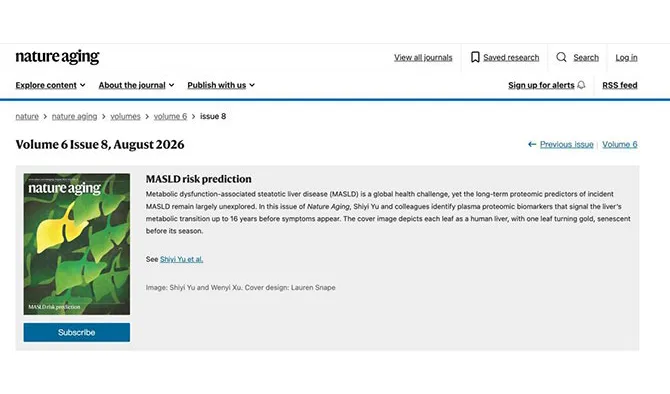
The team applied high-throughput plasma proteomics to stored samples from a multinational prospective cohort, then used machine learning to select a minimal protein panel that predicted later MASLD diagnosis. Five proteins carried most of the signal [1][2].
What the study found
The five-protein score separated people who would later develop MASLD from those who would not, with the strongest discrimination in the years closest to diagnosis but meaningful prediction as far back as 16 years. Because the cohort was prospective and multinational, the finding is less likely to reflect reverse causation than a cross-sectional study would be [1][2].
A risk score is not a treatment. The next questions are whether acting on a high score actually prevents MASLD or its progression, and whether the assay can be run cheaply and reliably at population scale. The authors present the model as a screening and stratification tool, not a diagnostic test [1][3].
The condition in context: MASLD
MASLD is the most common chronic liver disease worldwide and a growing cause of cirrhosis and liver cancer.
| Region | What the data shows | Source |
|---|---|---|
| Worldwide | MASLD affects about 25% of adults, making it the most common chronic liver disease [4]. | Guangdong liver research institute [4] |
| Natural history | It has a long asymptomatic subclinical phase, with molecular changes years before diagnosis [1]. | Hospital / Nature Aging [1] |
| Detection gap | Reliable prediction tools have been lacking, so preclinical identification is difficult [2]. | The Paper [2] |
Because the disease is reversible early and costly late, a decade of warning is clinically valuable — if it changes what patients and doctors do [1][4].
Why it matters
| Potential | What the report suggests | Source |
|---|---|---|
| Screening | A blood-based score could be used at population scale, unlike imaging [1]. | [1] |
| Timing | Up to 16 years of lead time creates room for lifestyle and medical intervention [1][2]. | [1][2] |
| Caution | Prediction is not prevention; clinical utility and cost need study [3]. | [3] |
Availability and limits
- This is an editorial summary of the hospital's and journal's reports, not a clinical recommendation [1][2].
- The model is a research tool; it is not yet a routinely available clinical test [1].
- Prediction accuracy varies with time to diagnosis and population [2].
- Whether early identification prevents MASLD progression has not been shown [3].
- Prevalence figures describe MASLD generally and come from secondary sources, not this study [4].
What to ask before booking
| Question | Why it matters |
|---|---|
| Am I at risk of MASLD by standard criteria? | Existing tools (imaging, liver enzymes, risk scores) remain the clinical standard [1]. |
| Is the five-protein test available to me? | It is a research model, not routine care [1]. |
| Which department handles foreign patients, and in what language? | Guangdong Provincial People's Hospital is a working hospital we do not book; confirm international-department coordination and language support. |
| What follow-up and lifestyle programme is offered? | Risk scores only help if paired with intervention [1]. |
Questions patients ask
What did the study build?
A plasma proteomics model using five proteins — FUOM, ACY1, KRT18, CDHR2 and GGT1 — that predicts MASLD up to 16 years before clinical diagnosis [1][2].
How large was the cohort?
More than 50,000 people in a multinational, multicentre prospective cohort [1].
Where was it published?
Nature Aging (IF 25.0), online 30 July 2026, and selected as the August 2026 cover article [3][4].
Is the test available now?
No — it is a research model; clinical validation and implementation are still needed [1].
Is this relevant to international patients?
It is useful context for China's liver-disease research. Guangdong Provincial People's Hospital is a working hospital we do not book — contact its international department directly for appointments and language support [1][2].