
Quick answer
About 70% of breast cancers are luminal — hormone-receptor-positive, HER2-negative — and they are treated as one disease: endocrine therapy, then a CDK4/6 inhibitor, then chemotherapy. But they are not one disease, and after CDK4/6 inhibitors fail there is no standard second line. Shao Zhimin's team at Fudan University Shanghai Cancer Center had already split luminal cancer into four molecular subtypes — classic luminal, immunomodulatory, proliferative and RTK-driven. LINUX tested whether matching a drug to the subtype works, using an AI model to assign patients. It did, in two of the four subtypes. The trial was published in Cancer Cell on 4 December 2025 [1][2][5].
Key takeaways
- Design: multicentre, randomised, controlled phase II platform trial [1][2].
- Population: advanced luminal breast cancer after resistance to CDK4/6 inhibitors [1][4].
- Subtypes: SNF1 classic luminal, SNF2 immunomodulatory, SNF3 proliferative, SNF4 RTK-driven, published by the same group in 2023 [2][5].
- Method: an AI model assigns subtype from molecular data, then a matched targeted drug is given [1][3].
- Result: significantly improved efficacy in the immunomodulatory and RTK-driven subtypes [1][3][6].
Why a platform trial rather than a single comparison
A conventional trial asks whether drug A beats drug B across a population. A platform trial asks whether matching treatment to biology beats not matching it, across several biology-defined groups at once, with arms added or dropped as data accumulate. For a disease that is 70% of breast cancer, that design is the only practical way to test four hypotheses in parallel [1][2].
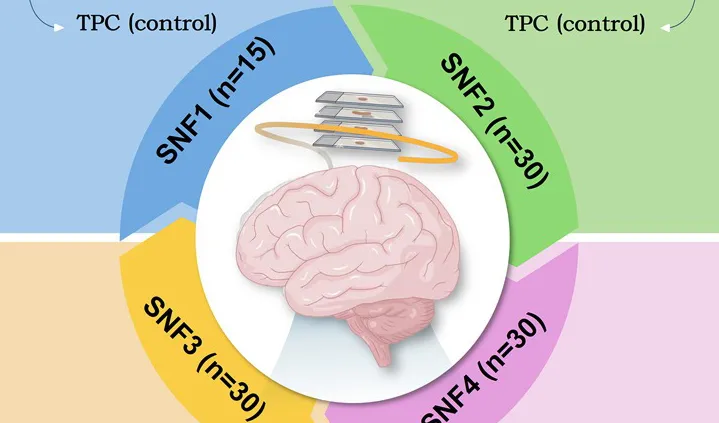
The mechanistic logic differs by subtype: immunomodulatory tumours may respond to immunotherapy, RTK-driven tumours to kinase inhibition, proliferative tumours to chemotherapy, and classic luminal tumours to further endocrine manipulation. LINUX's contribution is showing that at least two of these matches translate into better outcomes [3][5].
Reading a phase II platform result
This is a randomised phase II trial, not a phase III registration study. It establishes that the strategy is active and that the subtypes are real, which is a prerequisite for a definitive trial [1][4].
Splitting a trial four ways leaves each comparison with a modest sample, so subgroup effect sizes carry wide confidence intervals; one Chinese report described survival as doubled, which is the kind of claim that a phase II subgroup cannot by itself support. The subtyping test must also be reproducible outside the originating laboratory before it can guide treatment elsewhere. And AI assignment is only as good as the training data, which came from this group's cohorts — performance in other populations is unverified [2][3][5].
The condition in context: luminal breast cancer
It is the largest breast cancer subgroup and the one with the longest treatment course.
| Region | What the data shows | Source |
|---|---|---|
| Share | About 70% of breast cancers are luminal [1][3]. | Fudan / People's Daily [1][3] |
| Standard | Endocrine therapy, with CDK4/6 inhibitors extending survival in advanced disease [1]. | Fudan [1] |
| Post-progression gap | After CDK4/6 resistance, regimens are inconsistent and outcomes poor [1][3]. | Fudan / People's Daily [1][3] |
Because this subgroup is so large, even a modest improvement translates into many patients — and so does a wasted ineffective line [2].
Why it matters
| Potential | What the report suggests | Source |
|---|---|---|
| Treatable subtypes | Two of four subtypes now have matched options [1][3]. | [1][3] |
| AI in trial design | First use of an AI model to drive clinical trial assignment in this disease [1][5] | [1][5] |
| Caution | Phase II; small per-subgroup samples [2][4] | [2][4] |
Availability and limits
- This is an editorial summary of the publication, not a treatment recommendation [1][2].
- Phase II evidence does not establish a new standard of care [4].
- The subtyping assay is research-grade and not yet widely available [3].
- AI model performance outside the training population is unverified [5].
- Standard endocrine and chemotherapy options remain appropriate for many patients [1].
What to ask before booking
| Question | Why it matters |
|---|---|
| Has my tumour been subtyped beyond hormone receptor and HER2 status? | The subtype determines which match applies [2]. |
| Is this subtyping test available clinically here? | It remains a research assay [3]. |
| Which department handles foreign patients, and in what language? | The centre is a working hospital we do not book; confirm international-department coordination and language support. |
| What are my options after CDK4/6 inhibitor progression? | This is the population the trial studied [1]. |
Questions patients ask
What did LINUX test?
Whether assigning treatment according to an AI-derived molecular subtype improves outcomes in advanced luminal breast cancer after CDK4/6 inhibitor resistance, in a randomised phase II platform trial [1][2].
What were the four subtypes?
Classic luminal (SNF1), immunomodulatory (SNF2), proliferative (SNF3) and RTK-driven (SNF4), first published by the same team in 2023 [2][5].
Did it work?
Yes in the immunomodulatory and RTK-driven subtypes, where matched targeted drugs significantly improved efficacy [1][3].
Where was it published?
Cancer Cell, online 4 December 2025 [1][2].
Is this relevant to international patients?
It is useful context for China's breast cancer research. The centre is a working hospital we do not book — contact its international department directly [1].