
Quick answer
The DESCEND phase III non-inferiority trial, led by Professor Jian Zhang of Fudan University Shanghai Cancer Center across 28 centres, tested whether the steroid dexamethasone can be reduced or even dropped from standard antiemetic regimens. In 644 patients receiving highly emetogenic chemotherapy, adding netupitant/palonosetron (NEPA) and olanzapine let a reduced-dose or steroid-free arm match standard dosing for controlling nausea and vomiting — while cutting steroid side effects [1][3].
Key takeaways
- Standard antiemetic regimens use dexamethasone for four days, but even short steroid courses may blunt immunotherapy's effect — creating a "stop vomiting vs protect immunity" dilemma [2][4].
- DESCEND compared standard dexamethasone, a reduced one-day dose, and no dexamethasone, all on a base of NEPA plus olanzapine [3][4].
- Overall complete response (no vomiting, no rescue drug, 0–120 hours) was 72.4% standard, 72.2% reduced, and 70.1% steroid-free — the latter two non-inferior [3].
- Reducing or removing steroids significantly lowered anxiety and insomnia and improved quality of life; the steroid-free arm had slightly weaker early nausea control but better overall tolerability [3].
- Results were reported at ASCO 2026 and published in the Journal of Clinical Oncology (impact factor 44.7) [1][2].
The problem it addresses
Highly emetogenic chemotherapy causes nausea and vomiting in most patients without prophylaxis. Dexamethasone is a workhorse of antiemetic regimens, but as checkpoint inhibitors and antibody-drug conjugates become standard, evidence that steroids can suppress anti-tumour immunity has grown — so clinicians increasingly want to spare steroids, especially in patients on immunotherapy [2][4].
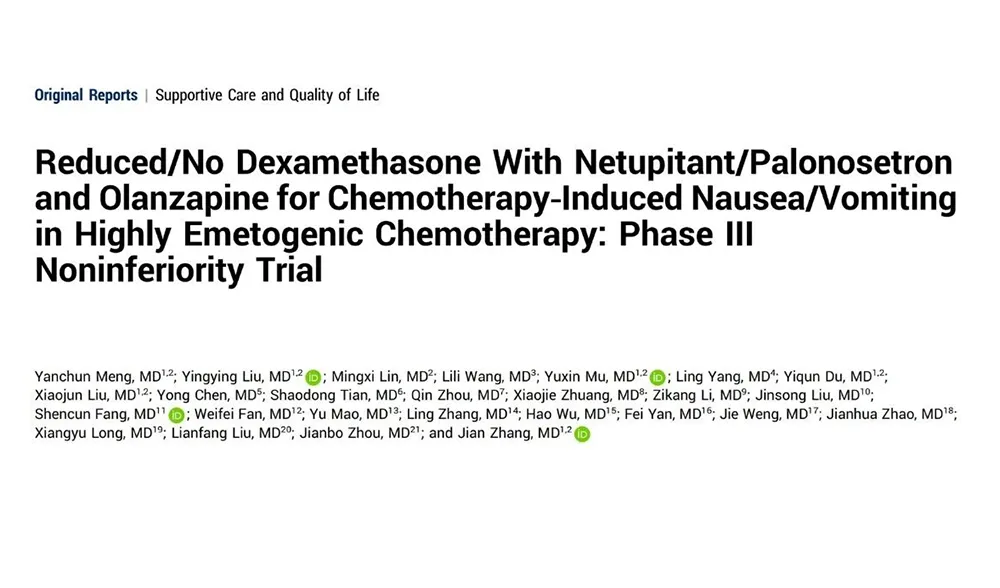
DESCEND was designed as an investigator-initiated 1:1:1 non-inferiority trial: standard dexamethasone (12 mg day 1, 8 mg days 2–4), a reduced one-day 6 mg dose, or no dexamethasone, with NEPA plus olanzapine in all arms [3][4].
What the trial found
Across 644 patients, the primary endpoint — overall complete response over 0–120 hours — was essentially flat across arms (72.4%, 72.2%, and 70.1%), meeting non-inferiority for the reduced and steroid-free strategies. Acute- and delayed-phase secondary outcomes also showed no significant difference [3].
The steroid-free arm had slightly less early nausea control. The practical message is stratification — reduced steroids for chemo-immunotherapy patients to preserve immunity, and a steroid-free option for patients who cannot take steroids — rather than dropping steroids universally [3][4].
The condition in context: chemotherapy-induced nausea and vomiting
CINV is among the most distressing side effects of cancer treatment and can lead patients to delay or refuse curative chemotherapy.
| Region | What the data shows | Source |
|---|---|---|
| Worldwide | Nausea and vomiting are common, feared side effects of cancer treatment, driving adherence problems and distress [5]. | US National Cancer Institute [5] |
| The dilemma | Standard antiemetics use steroids for days, but short steroid exposure may blunt immunotherapy [2][4]. | Fudan reports [2][4] |
| China | DESCEND ran across 28 Chinese centres with 644 patients, led by Fudan's Jian Zhang [1][2]. | Fudan / JCO [1][2] |
Because CINV affects so many patients, a regimen that controls it while sparing immunity could shift supportive care in the immunotherapy era [1][5].
Why it matters
| Potential | What the report suggests | Source |
|---|---|---|
| Practice | A high-quality non-inferiority result could change standard antiemetic dosing [1][3]. | [1][3] |
| Immunity | Steroid-sparing may help preserve immunotherapy benefit [2][4]. | [2][4] |
| Caution | Steroid-free slightly weakens early nausea control; choice should be individualised [3]. | [3] |
Availability and limits
- This is an editorial summary of hospital, university and journal reports, not an independent clinical assessment or a booking channel [1][2][3].
- DESCEND is a completed trial whose results are published; it informs practice, but applying it still depends on local guidelines and each patient's regimen [1][3].
- Results are for highly emetogenic chemotherapy with NEPA plus olanzapine; other settings may differ [3].
- The steroid-free arm had slightly weaker early nausea control, so steroid-sparing should be individualised [3].
- Burden statements describe CINV generally and come from the NCI, not this trial [5].
What to ask before booking
| Question | Why it matters |
|---|---|
| Do I need steroids for antiemetic cover, or can they be reduced? | DESCEND supports steroid-sparing in many cases; ask whether your regimen fits [1][3]. |
| Am I on immunotherapy, where steroids may matter? | If you are, a reduced-steroid plan may be preferred; discuss with your oncologist [2][4]. |
| Which department handles foreign patients, and in what language? | Fudan Cancer Center is a working hospital we do not book; confirm international-department coordination and language support. |
| How is antiemetic follow-up handled around travel? | Nausea control is monitored across cycles; plan for continuity of prescriptions. |
Questions patients ask
What is the DESCEND trial?
A phase III non-inferiority trial led by Fudan University Shanghai Cancer Center's Jian Zhang across 28 centres, testing whether dexamethasone can be reduced or dropped from antiemetic regimens for highly emetogenic chemotherapy [1][2].
What did it find?
Overall complete response was 72.4% with standard dexamethasone, 72.2% with a reduced dose, and 70.1% with no steroids — the latter two non-inferior — with fewer steroid side effects like anxiety and insomnia [3].
Why would you want to avoid steroids?
Standard antiemetics use dexamethasone for four days, but even short steroid exposure may weaken immunotherapy's anti-tumour effect, and steroids cause insomnia, high blood sugar and other problems [2][4].
Is the steroid-free regimen recommended for everyone?
No. The steroid-free arm had slightly weaker early nausea control, so the strategy is individualised — reduced steroids for chemo-immunotherapy patients, and a steroid-free option for those who cannot take steroids [3].
Is this relevant to international patients considering cancer care in China?
It is useful context for China's supportive-care research. Fudan Cancer Center is a working hospital we do not book — contact its international department directly and confirm candidacy, language support and travel logistics [1][2].