
Quick answer
After surgery for stage I–III colorectal cancer, patients are usually followed with CT scans and CEA blood tests — waiting for a recurrence to grow large enough to see. The Phase III FIND trial tested a different rhythm: a blood test for ctDNA methylation, repeated over time, that triggers imaging as soon as tumour DNA reappears. Among 584 patients, this raised the share whose recurrence could be treated with curative intent from 23.6% to 48.1% [1][2][3].
Key takeaways
- 584 patients randomised: 289 to ctDNA methylation-guided surveillance, 295 to standard CT follow-up [3].
- The ctDNA arm used a single-tube multiplex methylation-specific PCR covering 10 methylation markers; a positive result triggered immediate CT [3].
- Curative-intent treatment of recurrence: 48.1% versus 23.6% (P=0.008) [1][2].
- For liver- or lung-limited recurrence, curative resection was 42.3% versus 18.2% [3].
- Overall recurrence rates were similar between arms — the difference was in how early and how treatable recurrences were found [3].
The problem and the design
Seventy to eighty per cent of colorectal cancers are non-metastatic at diagnosis, but 10–30% recur after surgery, mostly within two years and most often in the liver or lungs. Whether a recurrence can be removed or ablated determines long-term survival, and fixed-interval CT often catches it too late for that [3].
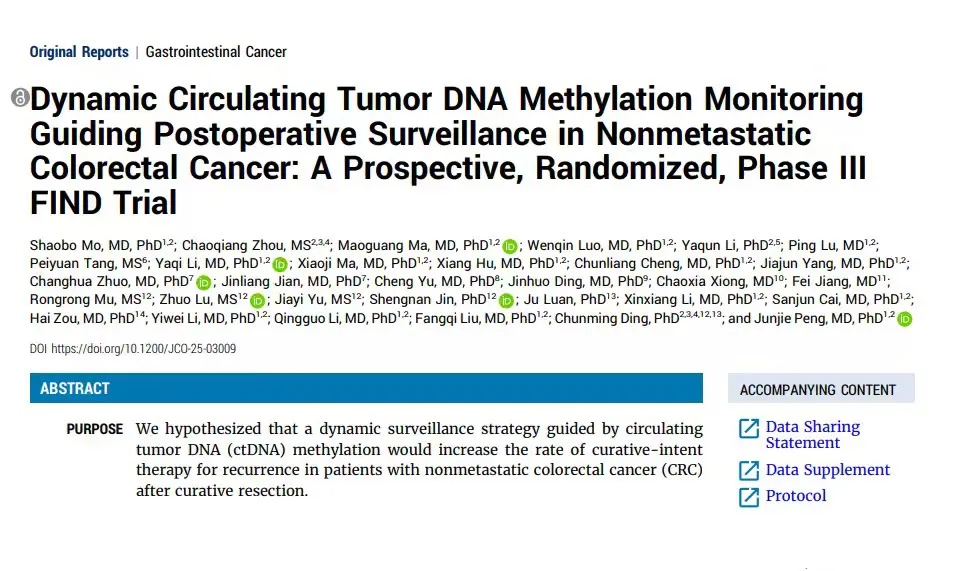
FIND, led by Peng Junjie (colorectal surgery) and Ding Chunming (pathology) at Fudan University Shanghai Cancer Center, randomised patients to the ctDNA-guided strategy or standard CT-based follow-up. In the ctDNA arm, a positive test prompted immediate imaging; two consecutive negatives allowed follow-up intervals to be relaxed [2][5].
What the trial found
At a median follow-up of 23.3 months, the two arms had similar recurrence rates, but the ctDNA arm's recurrences were far more often amenable to curative treatment. The effect was strongest for liver and lung recurrences, where curative resection rates roughly doubled [1][3][4].
The primary endpoint is the proportion treated with curative intent, not overall survival; longer follow-up is needed to show that earlier detection actually extends life. The trial is Chinese and multicentre, and the assay is a specific 10-marker methylation panel, so results may not transfer directly to other ctDNA tests [2][3].
The condition in context: colorectal cancer
Colorectal cancer is among the most common cancers worldwide and one of the most curable when caught early.
| Region | What the data shows | Source |
|---|---|---|
| Recurrence | 10–30% of resected stage I–III patients recur, mostly within two years [3]. | Science and Technology Daily [3] |
| Detection | Under conventional follow-up, only about 15% of recurrences are caught at a curative stage [3]. | Science and Technology Daily [3] |
| China | FIND is a national multicentre trial led by a Shanghai centre [1][2]. | Fudan University [1] |
Because salvage surgery is the main route to cure after recurrence, shifting detection earlier is one of the few levers that can change outcomes without a new drug [1].
Why it matters
| Potential | What the report suggests | Source |
|---|---|---|
| Treatability | Doubles the share of recurrences treated curatively [1][2]. | [1][2] |
| Workflow | Positive-trigger imaging and relaxed intervals for negatives is practical [5]. | [5] |
| Caution | Survival benefit not yet demonstrated; assay-specific [2][3]. | [2][3] |
Availability and limits
- This is an editorial summary of the publication and hospital reports, not a clinical recommendation [1][2].
- The primary endpoint is curative-intent treatment, a surrogate for survival [2].
- The 10-marker methylation panel is specific to this trial and not a generic ctDNA test [3].
- Cost and reimbursement for serial ctDNA testing vary [5].
- Guidelines have not yet adopted ctDNA-guided surveillance as standard [2].
What to ask before booking
| Question | Why it matters |
|---|---|
| Is ctDNA monitoring appropriate for my stage and risk? | The trial enrolled stage I–III after curative surgery [3]. |
| Which assay will be used, and how often? | Results are assay-specific and schedule-dependent [3][5]. |
| Which department handles foreign patients, and in what language? | Fudan's cancer centre is a working hospital we do not book; confirm international-department coordination and language support. |
| What happens if a test is positive? | The strategy depends on rapid imaging and multidisciplinary review [5]. |
Questions patients ask
What is the FIND trial?
A Chinese multicentre, prospective, randomised Phase III trial testing ctDNA methylation-guided surveillance versus standard CT follow-up after curative surgery for stage I–III colorectal cancer [1][2].
What did it show?
Curative-intent treatment of recurrence rose from 23.6% to 48.1% (P=0.008); for liver/lung recurrence, curative resection was 42.3% versus 18.2% [1][3].
Does it improve survival?
Not yet shown — the primary endpoint is curative-intent treatment; overall survival needs longer follow-up [2].
Where was it published?
Journal of Clinical Oncology, online 29–30 July 2026, with an editorial from Memorial Sloan Kettering [1][2].
Is this relevant to international patients?
It is useful context for China's colorectal-cancer follow-up. Fudan University Shanghai Cancer Center is a working hospital we do not book — contact its international department directly [1].