
Quick answer
A routine single implant in a Chinese tertiary public hospital costs about $800 (5,700 yuan), and that figure is built from three published numbers rather than quoted by a clinic: up to $640 (4,500 yuan) for the medical service, around $130 (900 yuan) for the implant itself after centralised procurement, and around $43 (300 yuan) for the crown [1][2][3]. In the US, the UK, Germany and Australia the same treatment is priced by the private market, and typically lands between the equivalent of 14,000 and $5,000 (35,000 yuan). Turkey is cheaper than all of them — and there are still reasons to choose China over Turkey, which we set out directly [4][5][6].
Key takeaways
- China's national average for a single implant fell from about $2,140 (15,000 yuan) to 6,000–$1,000 (7,000 yuan) after the 2022–2023 price action [2].
- The regulated service fee covers diagnosis, imaging, placement and crown fitting — but not extraction, grafting or gum surgery [1].
- Implant hardware after procurement costs 548–$260 (1,855 yuan), averaging about 900 [3].
- In most other countries the price is a private-market price, and statutory insurance rarely covers implants [5][6].
- Two visits three to six months apart is the normal pathway, which changes the true cost of travelling for it.
First, define “one implant”
Half of the variation between quotes is not price at all. It is the definition.
| Definition | What is included | Where you see it |
|---|---|---|
| A. Fixture only | The titanium screw, nothing else | Headline prices in advertising |
| B. Complete tooth | Fixture, abutment and crown | The comparison in this article |
| C. Complex case | B plus grafting, sinus lift or extraction | Quoted after a CBCT scan |
Every figure below is definition B unless stated otherwise. A quote that does not say which definition it uses is not a quote.
China: three published numbers, not one clinic's price list
In September 2022 the National Healthcare Security Administration issued a dedicated price action on dental implant care, fully implemented by May 2023 [1]. It split the cost into three parts and regulated each.
| Component | Regulated price | What it covers |
|---|---|---|
| Medical service fee | Up to $640 (4,500 yuan) at tertiary public hospitals | Consultation, blood tests, imaging, implant placement, crown fitting, scan and design [1][3] |
| Implant system (procured) | $78–265 (548–$260 (1,855 yuan)), average about $130 | 40 selected products; average price down 55% on pre-procurement purchasing [3] |
| Crown (tendered) | $14–94 (100–$90 (656 yuan)), average about $43 | Ceramic crown after competitive listing [3] |
| Typical total | About $800 (5,700 yuan) | Routine single implant, definition B |
Two exclusions matter. The 4,500-yuan service package does not include extraction, periodontal cleaning, root canal treatment, bone grafting or soft-tissue surgery — each is a separate item [1]. And these are public-hospital prices: private clinics set their own, so a quote from a private practice in Shanghai or Beijing is not evidence that the regulated price failed.
The national effect is documented by the regulator itself: the average single implant fell from about $2,100 to $860–1,000 (15,000 yuan to 6,000–$1,000 (7,000 yuan)), and roughly 18,000 institutions joined the procurement programme [2].
The comparison
| Country | Single implant, complete tooth | In USD | How the price is set |
|---|---|---|---|
| China (public hospital) | About $800 (5,700 yuan) | ~800 | Regulated fee plus procured hardware [1][3] |
| Turkey | €400–800 | 440–890 | Private clinic market, often packaged with transfers and hotel |
| United Kingdom (private) | £2,000–2,500 | 2,570–3,290 | Private market; NHS provision is exceptional [4] |
| Germany | €1,800–3,000 | 2,000–3,290 | Private fee schedule; statutory cover excludes implants [5] |
| United States | $3,000–5,000 | 3,000–5,000 | Private market, insurance rarely covers [6] |
| Australia | A$4,000–6,000 | 2,710–4,000 | Mainly private practice |
The non-Chinese ranges are indicative, compiled from published private-clinic price lists in 2026 rather than from national statistics, and we label them that way on purpose. Only the Chinese row can be traced to a government document line by line.
That is the real difference, and it is subtler than “five times cheaper”. In China a routine implant is a regulated public service; almost everywhere else it is a private retail purchase.
Where the gap comes from
| Factor | Effect |
|---|---|
| Who pays | Implants sit outside most statutory benefits, so prices are market prices [5] |
| Procurement | China's centralised buying cut hardware to an average of about $130 [3] |
| Labour | Implantology is dentist-time intensive; wage levels differ several-fold |
| Practice overhead | Insurance billing, marketing and premises are priced into private fees |
| Liability cover | Professional indemnity is a real line item in some markets |
Five things the price does not tell you
- Bone. If you have lost bone, grafting adds cost and three to six months before the implant goes in. Ask for the CBCT finding, not an opinion.
- Brand. Within one clinic, a premium system and a value system can differ two- to three-fold. China's procurement list has 40 products across that range [3].
- Number of visits. The routine pathway is two: placement, then the crown after osseointegration. “Teeth in a day” applies to selected cases, not to everyone.
- Warranty. A manufacturer's lifetime warranty on the fixture is not the clinic agreeing to redo the work. Ask who is responsible, for how many years, and under what conditions.
- Who treats peri-implantitis. The commonest long-term problem needs a dentist near your home. If nobody will take it on, the saving evaporates.
The two-trip reality
An implant is not a one-visit procedure. The normal sequence is: first trip for assessment, any grafting and placement — about three to seven days; then three to six months of healing while the implant integrates; then a second trip of three to five days for impressions and the crown.
So the number to compare is not the treatment fee. It is: treatment + two return flights + two lots of accommodation + lost work + the cost of a third trip if something fails. Dental-tourism packages in Turkey compress this by favouring same-day or single-visit protocols, which is legitimate for straightforward cases and inappropriate for complex ones.
The condition in context: what makes an implant succeed
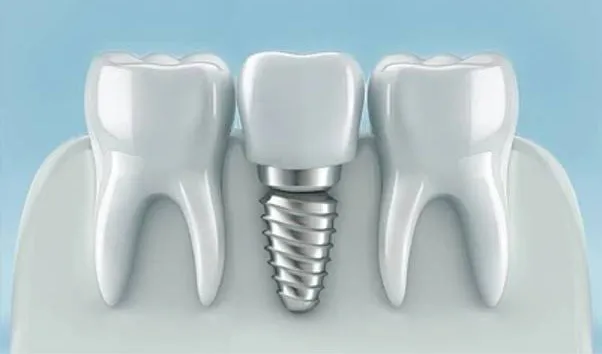
An implant is a titanium root placed in bone, left to fuse with it over three to six months, then loaded with a crown. Success is not decided by the price list. It is decided by four things: bone volume and quality, the absence of active infection, the patient's healing capacity, and whether the load is distributed sensibly.
That is why the same 5,700-yuan implant can be a good decision for one patient and a poor one for another. Smokers, people with poorly controlled diabetes, and patients with untreated periodontal disease have materially higher failure rates. So does anyone who grinds heavily and is given a single implant supporting a bridge.
Reported long-term survival for single implants is high in well-selected patients, but the number that matters to you is the one from the clinic treating you, for cases like yours. Ask for it, and ask what they count as failure.
China or Turkey? A direct comparison
Turkey is the obvious alternative, it is cheaper on paper, and pretending otherwise would not help anyone. Here is where each one wins.
| Question | China | Turkey |
|---|---|---|
| Can I verify the price before booking? | Yes — a published fee cap, a procurement list and a public list of participating hospitals [1][3] | Clinic by clinic; no national schedule |
| Complex grafting or full-mouth reconstruction | Tertiary stomatology hospitals with maxillofacial and grafting teams | Mainstream clinics are geared to straightforward cases |
| Medically fragile patients | Hospital setting with anaesthesia, ICU and internal medicine on site | Often standalone clinics |
| Cost of the implant alone | Higher than Turkey | Lower |
| Package convenience | Limited; you arrange most of it | Mature packages with transfers and hotels |
| Language at the chair | Improving, but a real barrier outside international departments | Widely offered in European languages |
The honest summary: Turkey wins on price and convenience for a healthy patient with good bone and one missing tooth. China wins when the case is not simple, when you want a price you can audit, or when you need a hospital rather than a clinic.
If your case is a single implant in healthy bone and you are paying cash, Turkey will probably be cheaper than China even after flights. We would rather say that than have you find out afterwards.
When not to travel for dental work
| Situation | Why |
|---|---|
| Major grafting or sinus lift needed | Complexity rises, and a redo costs another trip |
| Uncontrolled diabetes, heavy smoking, active periodontal disease | Failure rates rise sharply; local follow-up matters more than price |
| The saving is a few hundred dollars | It will not cover two trips and the risk |
| Full-arch reconstruction | Large sums, multiple visits, serious complications if it goes wrong |
| No dentist at home willing to maintain it | Peri-implantitis is a long-term management problem |
Decision checklist
| Question | If yes |
|---|---|
| Have I had a CBCT and do I know my bone volume? | Get quotes against it |
| Is the quote definition B, including abutment and crown? | Comparable |
| Do I accept two trips three to six months apart? | Workable |
| Do I have a dentist at home who will maintain it? | Essential |
| Does the saving exceed the full travel cost? | Financially rational |
Availability and limits
- The Chinese figures come from government documents and a regulator press conference [1][2][3].
- Non-Chinese figures are indicative private-market ranges, not national statistics.
- Prices exclude grafting, extractions and gum treatment unless stated [1].
- Implant success depends on bone quality, smoking, diabetes control and hygiene, not on the country [4].
- We are not a provider and do not book treatment; where coordination is mentioned it is as a route, not a recommendation.
What to ask before booking
| Question | Why it matters |
|---|---|
| Which implant system, and what does it cost separately? | Hardware is the most variable line [3]. |
| Does this price include the abutment and the crown? | That is the difference between definition A and B. |
| Which department handles foreign patients, and in what language? | We do not book treatment; confirm the international department and its language support. |
| If the implant fails, who replaces it and who pays? | Warranty terms are rarely what patients assume. |
| How many visits, and how far apart? | Determines the real cost of travelling. |
Questions patients ask
How much is a dental implant in China?
About $810 (5,700 yuan) for a routine single implant at a tertiary public hospital: up to 4,500 for the service, around 900 for the implant and around 300 for the crown. Grafting, extractions and gum treatment are charged separately [1][3].
Is Turkey cheaper than China for implants?
Usually yes for a straightforward single implant in healthy bone, at roughly EUR 400-800 against about $810 (5,700 yuan). China's advantages are a verifiable regulated price, hospital backup for complex or medically fragile cases, and tertiary stomatology centres for grafting and reconstruction.
Does insurance cover implants?
Rarely. In Germany implants are excluded from statutory benefits, in the UK NHS provision is exceptional, and US dental plans commonly exclude or cap them. China's regulated price is a self-pay price [4][5][6].
How many trips does an implant need?
Two, normally: three to seven days for assessment and placement, three to six months of healing, then three to five days for impressions and the crown. Same-day protocols suit selected cases only.
Is a cheap implant a bad implant?
Not necessarily, but the system, the surgeon's volume and the follow-up matter more than the price. Ask which system is used, how many of these the surgeon places each year, and who treats complications afterwards.