
Quick answer
Third-generation EGFR inhibitors are the standard first-line treatment for EGFR-mutant lung cancer, and in most patients they work well for a year or more. But roughly 50–60% of these tumours also carry a mutation in a tumour-suppressor gene — most often TP53, sometimes RB1, PTEN or APC — and in those patients monotherapy fails sooner. Wang Jie's team at the Cancer Hospital of the Chinese Academy of Medical Sciences designed ACROSS2 to test whether adding chemotherapy to the inhibitor fixes that gap. It did: the combination significantly prolonged progression-free survival in 126 patients, published in CA: A Cancer Journal for Clinicians on 12 March 2026 [1][2][4].
Key takeaways
- Global first phase III trial designed specifically for EGFR-mutant NSCLC with tumour-suppressor gene co-mutations [2][3].
- Regimen: aumolertinib plus carboplatin-pemetrexed versus aumolertinib alone [5].
- 126 patients enrolled; open-label, multicentre, randomised phase III design [6].
- The combination met its primary endpoint of significantly longer progression-free survival [1][4].
- The benefit was most clearly established in the TP53 co-mutated subgroup [1][2].
Why co-mutations matter
EGFR mutations are found in 40–60% of Asian lung adenocarcinomas, and co-occurring alterations are present in up to 92.9% of them — which is why outcomes in "EGFR-mutant lung cancer" vary so much. Tumour-suppressor loss is the clinically important subset: these tumours respond less well and become resistant sooner, and until now there was no randomised evidence for intensifying first-line treatment in this specific group [4][5].
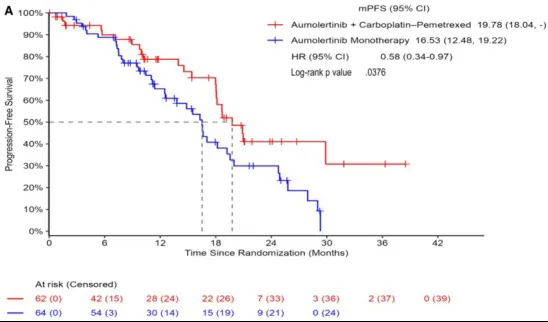
Earlier trials had already suggested that EGFR inhibitors plus platinum chemotherapy beat monotherapy in unselected EGFR-mutant populations. ACROSS2's contribution is to test that in a molecularly defined, higher-risk group, so that intensification is offered to the patients who need it rather than to everyone [2][4].
What it means in practice
For a patient whose tumour sequencing shows an EGFR sensitising mutation plus a TP53 mutation, the trial supports starting with the combination rather than the inhibitor alone, at the cost of chemotherapy's toxicity and the burden of infusions [1][5].
Progression-free survival is a surrogate. The trial's reports do not yet demonstrate an overall survival benefit, and crossover and subsequent therapies will complicate that analysis. The sample of 126 is small for a phase III, the design is open-label, and the conclusion is subgroup-specific — patients without tumour-suppressor co-mutations should not be intensified on this evidence [3][6]. The accompanying editorial in the same journal frames the result as sharpening the case for early intensification rather than settling it [6].
The condition in context: EGFR-mutant lung cancer
Lung cancer is the leading cause of cancer death worldwide, and EGFR-mutant disease is the most common actionable subtype in East Asia.
| Region | What the data shows | Source |
|---|---|---|
| Prevalence | EGFR mutations occur in 40–60% of Asian lung adenocarcinoma [4]. | China Medical Information Herald [4] |
| Co-mutation rate | Up to 92.9% of EGFR-mutant tumours carry another alteration; TP53 is the most consequential [4]. | China Medical Information Herald [4] |
| Standard | Third-generation EGFR-TKI monotherapy is first-line standard of care [5]. | Oncology World [5] |
Because first-line decisions set the ceiling for later survival, defining which patients need intensification is one of the highest-value questions in thoracic oncology [2].
Why it matters
| Potential | What the report suggests | Source |
|---|---|---|
| Precision | Intensification targeted at tumour-suppressor co-mutation rather than all-comers [2][4]. | [2][4] |
| Practice change | Supports combination first-line therapy in TP53 co-mutated disease [1][5]. | [1][5] |
| Caution | Small, open-label; no mature overall survival [3][6]. | [3][6] |
Availability and limits
- This is an editorial summary of the publication, not a treatment recommendation [1][2].
- Eligibility requires documented EGFR sensitising mutation plus tumour-suppressor co-mutation [4].
- Chemotherapy adds myelosuppression, nausea and infusion visits [5].
- Overall survival data are not yet mature [3].
- Results may not transfer to other EGFR inhibitors or other chemotherapy backbones [6].
What to ask before booking
| Question | Why it matters |
|---|---|
| Has my tumour been sequenced for co-mutations, not just EGFR? | The trial population was defined by co-mutation status [4]. |
| Does my TP53 status change the first-line plan? | The benefit was clearest in TP53 co-mutated disease [1][2]. |
| Which department handles foreign patients, and in what language? | The hospital is a working hospital we do not book; confirm international-department coordination and language support. |
| What is the plan if progression-free survival is short? | Resistance mechanisms differ in co-mutated tumours [5]. |
Questions patients ask
What did ACROSS2 test?
Aumolertinib plus carboplatin-pemetrexed versus aumolertinib alone as first-line therapy in EGFR-mutant NSCLC with tumour-suppressor gene co-mutations [5].
What was the result?
The combination significantly prolonged progression-free survival, meeting the primary endpoint; the benefit was clearest in TP53 co-mutated patients [1][2].
How many patients?
126, in an open-label, multicentre, randomised phase III design [6].
Where was it published?
CA: A Cancer Journal for Clinicians, online 12 March 2026 [1][2].
Is this relevant to international patients?
It is useful context for China's lung cancer practice. The hospital is a working hospital we do not book — contact its international department directly [1].