
Quick answer
A child with a channelopathy such as long QT syndrome may need a defibrillator for life. The standard device runs a lead through the veins into the heart, which in a growing child means a lifetime of lead-related risk: venous occlusion, endocarditis, tricuspid damage, and repeated revisions. A subcutaneous device avoids the veins but needs enough body fat to sit in. An extravascular ICD (EV-ICD) takes a third route — the lead is tunnelled behind the sternum, outside the circulation. On 27 February 2026, Wang Wei's team at Zhejiang University's children's hospital implanted one in a child, reported as the youngest recipient in China [1][2][5].
Key takeaways
- Date: 27 February 2026; device: Aurora EV-ICD with MRI SureScan [1].
- Operators: Wang Wei with Wang Yujia of cardiology and Ying Liyang of cardiac surgery [1].
- Mentored by Xu Wei of Nanjing Drum Tower Hospital; among the first batch nationally and the first at a Zhejiang children's hospital [1].
- Reported as the youngest patient in China to receive this procedure [1].
- The device is approved for the Chinese market and provides defibrillation, cardioversion and anti-tachycardia pacing [4].
Why the lead route matters in a child
A transvenous lead placed at age five must survive decades of growth, and each episode of lead failure means another procedure. Paediatric electrophysiologists therefore try to avoid the venous route when the anatomy allows, accepting a larger generator and a different defibrillation vector in exchange [2][4].
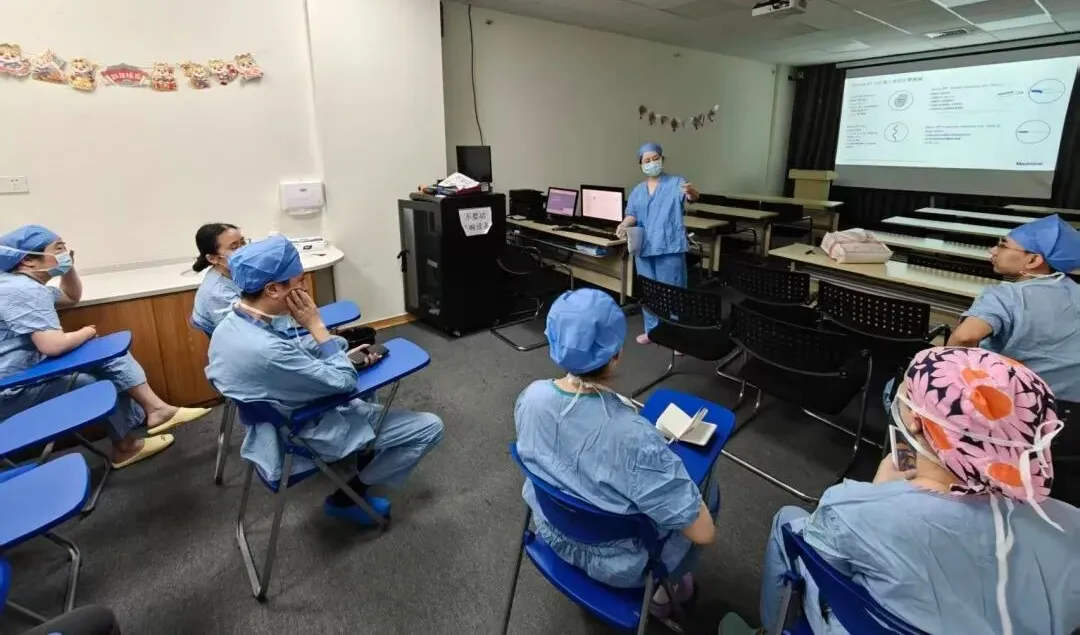
Paediatric anatomy complicates the standard technique. The xiphoid process is often still cartilaginous and impalpable, so the manufacturer's landmarks do not apply; teams adapt by outlining the costal margin and using a left paramedian incision, and by blunt rather than electrocautery dissection because the anterior rectus sheath is thin in children. Ossification of the sternal body also produces visible ridges that guide fluoroscopic navigation [4].
What a first case can and cannot show
The report documents technical success and feasibility in a small chest — the substantive achievement, since the anatomy is the obstacle. It does not report defibrillation threshold testing results in detail, complications, or follow-up [1].
Published paediatric EV-ICD series are small and short [6]. Adult data report high implant success but a meaningful rate of inappropriate shocks, and the paediatric adaptation adds uncertainties about lead position as the chest grows. Device field-safety notices should also be checked for the specific model and generation at any centre. Families should understand that this is a newer option with less long-term evidence than the transvenous device, not a strictly better one [3][4].
The condition in context: sudden cardiac death in children
Paediatric sudden death is rare but disproportionately tragic, and inherited arrhythmias are the commonest cause.
| Region | What the data shows | Source |
|---|---|---|
| Causes | Congenital arrhythmia, inherited cardiomyopathy and long QT syndrome predominate [1]. | DrVoice [1] |
| Why it is harder | Children have a shorter rescue window and a cardiovascular system still growing [1]. | DrVoice [1] |
| Device landscape | Transvenous, subcutaneous and extravascular systems each trade lead risk against size and vector [4]. | Baidu Baike [4] |
Because the alternative for a child with recurrent ventricular arrhythmia is often a device in any case, the choice is about which device, not whether [2].
Why it matters
| For the patient | What the report suggests | Source |
|---|---|---|
| No vascular lead | Avoids venous occlusion and endocarditis risk [2]. | [2] |
| MRI access | The device is MR-conditional [1]. | [1] |
| Caution | Small evidence base; inappropriate shock risk [3]. | [3] |
Availability and limits
- This is an editorial summary of hospital and industry reporting, not a treatment recommendation [1][2].
- Paediatric evidence is limited to small series and case reports [3].
- Device size and chest anatomy constrain eligibility in the smallest children [4].
- Inappropriate shocks and lead position with growth need long-term follow-up [3].
- Model-specific field safety notices should be checked [4].
What to ask before booking
| Question | Why it matters |
|---|---|
| Why this device rather than a transvenous or subcutaneous one? | Each avoids a different risk [4]. |
| Will the lead position still work as my child grows? | Growth is the central paediatric uncertainty [3]. |
| Which department handles foreign patients, and in what language? | ZJU Children's Hospital is a working hospital we do not book; confirm international-department coordination and language support. |
| What is the plan for inappropriate shocks and device revision? | Both are realistic eventualities [3]. |
Questions patients ask
What was implanted?
An Aurora EV-ICD, an extravascular implantable cardioverter-defibrillator whose lead sits behind the sternum rather than inside the heart [1][4].
Who performed it?
Wang Wei's team at Zhejiang University's children's hospital, with Wang Yujia and Ying Liyang, mentored by Xu Wei of Nanjing Drum Tower Hospital [1].
Why is it notable?
It is reported as the youngest-in-China case, in a child whose anatomy makes both transvenous and subcutaneous devices problematic [1].
Is it proven in children?
No — paediatric evidence consists of small series and case reports [3].
Is this relevant to international patients?
It is useful context for China's paediatric electrophysiology. The hospital is a working hospital we do not book — contact its international department directly [1].