
Quick answer
Equine-assisted therapy is used for autism in Europe and North America but has thin evidence, and almost none from China. In June 2025, Zhejiang University Children's Hospital — a national clinical research centre for child health — launched a large randomised trial with a professional equestrian base to test whether it actually works, rather than whether children enjoy it [1][2][3].
Key takeaways
- Described as China's first large randomised evaluation of equine-assisted therapy for autism run by a top children's hospital with an equestrian partner [2][3].
- Led by the hospital's rehabilitation department, with Li Haifeng as project lead and party secretary Shu Qiang sponsoring [1][3].
- Children are enrolled in five to six cohorts, with two two-hour sessions a week [3].
- The intervention combines social games, cognitive tasks, groundwork with the horse and riding [4].
- Funding and partners include the Zhejiang Disabled Persons' Welfare Foundation and a youth equestrian training base [3][5].
Why horses
The proposed mechanism is not the animal's company but its gait. A walking horse produces a rhythmic, three-dimensional swing that resembles human walking, which is thought to stimulate the vestibular system, balance and trunk control. Add the need to follow instructions, make eye contact and manage a large animal, and the session becomes a social and sensory task [1][3].
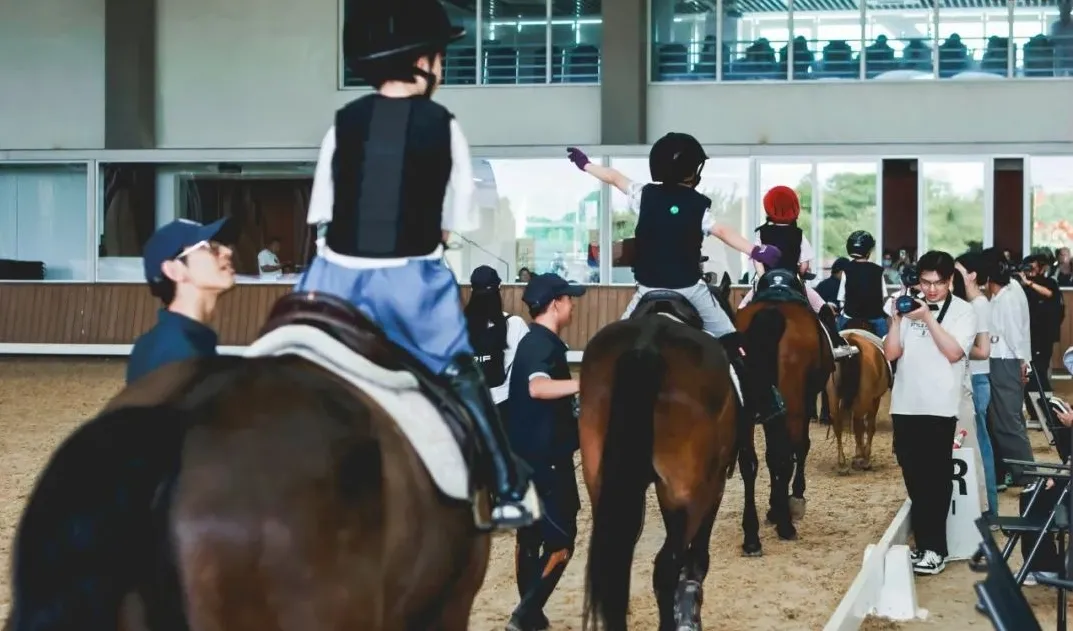
The hospital frames it as an adjunct, not a replacement: conventional behavioural and developmental interventions remain the base, and the question is whether riding adds measurable benefit on top [1][3].
What the trial will measure
The protocol randomises children to the equine programme or a comparison condition and follows standardised autism and functional scales. Because the intervention cannot be blinded — everyone knows whether a child is on a horse — the design depends on blinded assessors and pre-specified endpoints [2][3].
Equine therapy trials face three problems: placebo effects from a novel, enjoyable activity; inability to blind participants; and the cost and logistics of horses. A randomised design with blinded raters addresses the first two partly, but the trial will need enough participants to detect modest effects. No results have been reported yet [1][3].
The condition in context: autism in China
Autism prevalence is rising and conventional interventions have limited effect on core symptoms.
| Region | What the data shows | Source |
|---|---|---|
| China | Childhood autism incidence is described as rising steadily, a global public-health challenge [1][3]. | China News / Zhejiang Online [1][3] |
| Treatment gap | Traditional interventions progress slowly on core symptoms [3]. | Zhejiang Online [3] |
| Access | Equine therapy is established in Europe and the US but not widely used in China [1]. | China News [1] |
Because families often pay for complementary therapies out of pocket, knowing which ones work matters economically as well as clinically [3].
Why it matters
| Potential | What the report suggests | Source |
|---|---|---|
| Evidence | A randomised trial could settle a widely marketed but weakly evidenced therapy [2]. | [2] |
| Model | Hospital-club collaboration provides the setting and the horses [3]. | [3] |
| Caution | No results yet; blinding is impossible [1]. | [1] |
Availability and limits
- This is an editorial summary of launch reports, not a treatment recommendation [1][2].
- No outcome data have been published [3].
- Equine therapy carries injury risk and requires trained staff and suitable animals [1].
- Costs are typically borne by families [3].
- It should supplement, not replace, standard developmental care [1].
What to ask before booking
| Question | Why it matters |
|---|---|
| Is my child eligible for the trial or only for routine care? | Enrolment follows protocol criteria [3]. |
| What safety arrangements exist around the horses? | Injury risk is real for children with impaired attention [1]. |
| Which department handles foreign patients, and in what language? | ZJU Children's is a working hospital we do not book; confirm international-department coordination and language support. |
| What standard therapies continue alongside? | Equine therapy is an adjunct [1]. |
Questions patients ask
What launched?
A large randomised trial of equine-assisted intervention for children with autism, led by Zhejiang University Children's Hospital with a professional equestrian base, launched in June 2025 [1][2].
Why is it notable?
It is described as China's first large randomised evaluation of this therapy run by a top children's hospital [2][3].
How does the programme work?
Five to six cohorts, two two-hour sessions a week, combining social games, cognitive tasks, groundwork and riding [3][4].
Are results available?
Not yet — the trial is ongoing [1].
Is this relevant to international patients?
It is useful context for China's autism services. ZJU Children's Hospital is a working hospital we do not book — contact its international department directly [1].