
Quick answer
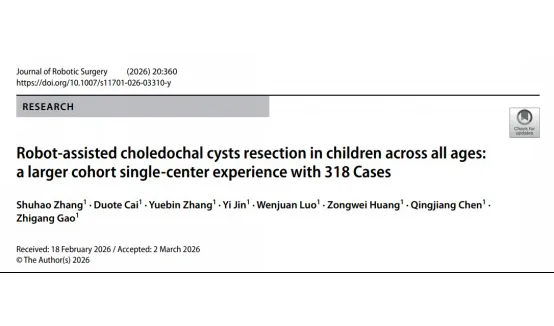
A choledochal cyst is a congenital ballooning of the bile duct that, if left alone, carries a rising risk of bile duct cancer with age — so the standard is early excision and reconstruction with a Roux-en-Y hepaticojejunostomy. Laparoscopy is the accepted approach; robotic surgery offers a three-dimensional view, articulated instruments and tremor filtering, but paediatric evidence has been thin. Gao Zhigang, who obtained his robotic credential in 2018 and directs the hospital's endoscopic surgery centre [4], has now published 318 robotic resections in children of all ages, compared with 489 laparoscopic cases [1][2][3].
Key takeaways
- Retrospective comparison of 318 robotic (RACC) against 489 laparoscopic (LAS) resections at one centre [2].
- All age groups included, from infants to adolescents [1][2].
- Described as the largest single-centre RACC series published since 2006 [2].
- Published in the Journal of Robotic Surgery on 19 March 2026 [1].
- Funded under China's National Key R&D Programme (2024YFC2707005) [1][5].
Why the operation is hard in children
The cyst sits adjacent to the portal vein and hepatic artery, and the reconstruction requires a small-calibre anastomosis between the hepatic duct and a Roux limb — in a patient whose ducts may be 2–3 mm across. Leak and stricture are the two failure modes, and both are exquisitely technique-dependent [1][2].
The robotic platform's advantage is at exactly that step: articulated wrists allow suturing at angles that straight laparoscopic instruments cannot reach in a small abdominal cavity, and the magnified 3D view helps identify the duct wall. The disadvantage is setup time and cost, plus the need for port placement that works in a small abdomen [1][3].
What the comparison shows
The study systematically evaluates safety and effectiveness of the robotic approach across ages, which the authors note had not previously been done — earlier reports were small and confined to older children. With 318 cases, the series can address questions that smaller studies cannot: whether outcomes differ in infants, whether conversion rates fall with experience, and whether anastomotic complications cluster early in the learning curve [2][3].
This is a retrospective comparison at one high-volume centre, so selection of which children got which operation was not random, and the surgical team's robotic experience grew over the study period. Operative time and cost are usually higher for the robotic approach. The paper establishes feasibility at scale; whether it is better than laparoscopy for a given child remains a judgement about anatomy and local expertise [1][2].
The condition in context: choledochal cyst
It is a rare congenital biliary malformation, more common in East Asia, and malignancy risk is the reason for early surgery.
| Region | What the data shows | Source |
|---|---|---|
| Malignancy risk | Untreated cysts carry increasing risk of biliary cancer with age, making early definitive surgery the only reliable strategy [1]. | ZJU Children's [1] |
| Standard operation | Laparoscopic cyst excision with Roux-en-Y hepaticojejunostomy [1]. | ZJU Children's [1] |
| Associated anomalies | Often coexists with intrahepatic duct dilatation and pancreatobiliary maljunction [1]. | ZJU Children's [1] |
Because the disease is rare, single centres accumulate experience slowly — which is why a 318-case series is a meaningful contribution [2].
Why it matters
| For the patient | What the report suggests | Source |
|---|---|---|
| Technical precision | Articulated instruments help with small-calibre anastomoses [1]. | [1] |
| Age coverage | Data now include infants, not only older children [2]. | [2] |
| Caution | Retrospective single-centre comparison; higher cost [3]. | [3] |
Availability and limits
- This is an editorial summary of a published series, not a treatment recommendation [1][2].
- Retrospective design without randomisation [2].
- Robotic systems add cost and require trained teams [3].
- Outcomes depend heavily on surgeon volume and experience [2].
- Long-term anastomotic stricture data beyond the study period are needed [1].
What to ask before booking
| Question | Why it matters |
|---|---|
| Is my child's cyst anatomy suitable for a minimally invasive approach? | Size and duct calibre affect feasibility [1]. |
| How many has the surgeon performed in children of my child's age? | Experience matters most in the smallest patients [2]. |
| Which department handles foreign patients, and in what language? | ZJU Children's is a working hospital we do not book; confirm international-department coordination and language support. |
| What is the plan for long-term follow-up of the anastomosis? | Stricture can present years later [1]. |
Questions patients ask
What was studied?
318 robotic choledochal cyst resections in children of all ages, compared with 489 laparoscopic cases at the same centre [2].
Where was it published?
The Journal of Robotic Surgery, online 19 March 2026 [1].
Why does it matter?
It is the largest single-centre robotic series for this operation since 2006 and covers all paediatric age groups [2].
Is robotic better than laparoscopic?
Not established — the comparison is retrospective and single-centre [2].
Is this relevant to international patients?
It is useful context for China's paediatric surgery. ZJU Children's Hospital is a working hospital we do not book — contact its international department directly [1].