
Quick answer
Zhejiang University Children's Hospital reached 4,000 Da Vinci robotic operations on 11 August 2026, six years after introducing China's first paediatric Da Vinci system in April 2020. It reports the highest single-centre paediatric robotic surgical volume in the world, and has published the largest single-centre study of robot-assisted choledochal cyst excision in children [1][3].
Key takeaways
- The 4,000th case was a splenectomy: under 50 minutes from incision to splenic mobilisation, less than 5 mL blood loss, four 0.5–1 cm umbilical incisions [1].
- The hospital installed China's first paediatric Da Vinci Xi on 8 April 2020 and did its first case that month [1][5].
- It took just over three years to reach 2,000 cases and another three years to reach 4,000 [1].
- It reports the world's highest single-centre volume among children's hospitals [1][2].
- Its surgeons have adapted robotic technique down to newborns under three months old [3].
How the volume was built
Paediatric robotic surgery is harder than adult robotic surgery: the abdominal cavity is smaller, the instruments are proportionally larger, and small children tolerate insufflation and long procedures poorly. Zhejiang University Children's Hospital started in April 2020 with a fourth-generation Xi system — the first in any Chinese children's hospital — and built volume steadily across urology, hepatobiliary, gastrointestinal and thoracic surgery [1][5].
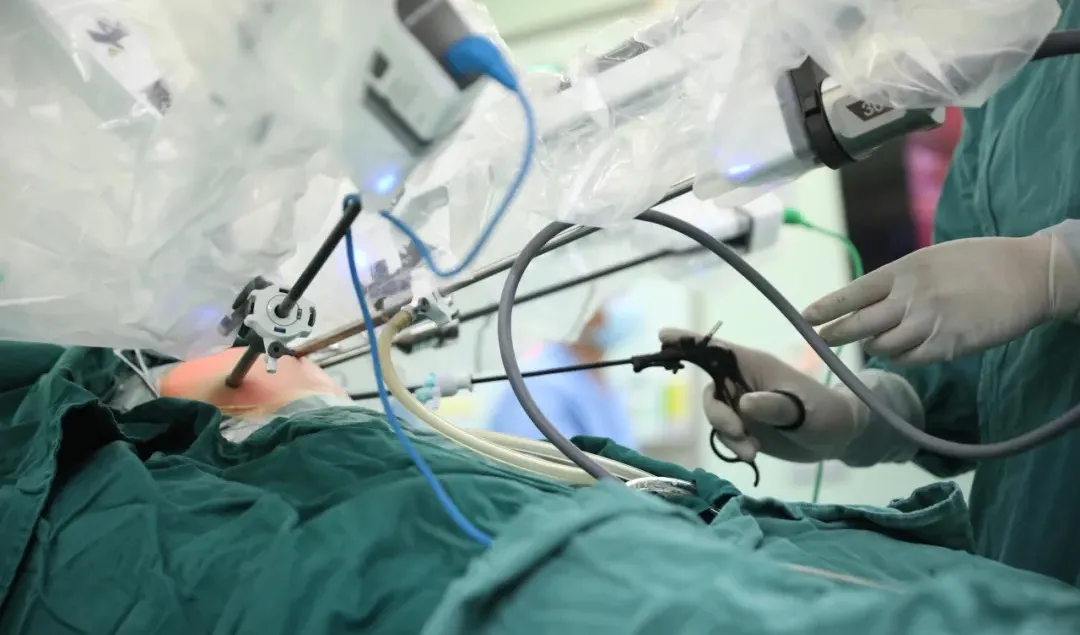
The 4,000th case illustrates the maturity: a splenectomy in which the magnified view and wristed instruments let the surgeon dissect the splenic hilum cleanly, with the spleen delivered through a small umbilical incision and almost no bleeding [1].
The evidence behind it
Volume alone would be a marketing number without evidence, and the hospital has published some. Its retrospective study of robot-assisted choledochal cyst excision covered 318 children operated robotically against 489 treated laparoscopically — the largest single-centre series of its kind since 2006 — and stratified patients into six age bands from newborns to 16 years [3].
The team also described technical modifications for infants under three months, including trocar spacing and a rubber-ring technique to lift the abdominal wall and enlarge the working space — the specific problem that makes neonatal robotics difficult [3].
The condition in context: paediatric surgery in China
China's paediatric surgical capacity is concentrated in a small number of national centres, and minimally invasive technique has spread unevenly.
| Region | What the data shows | Source |
|---|---|---|
| China | Zhejiang University Children's Hospital reports 44,200 operations in 2025 across three campuses [4]. | National research centre [4] |
| Access | The hospital is a national clinical research centre and national regional medical centre for children [4]. | National research centre [4] |
| Complexity | Its robotic programme covers newborns to adolescents, including hepatobiliary reconstruction [3]. | Hospital study [3] |
For families, the practical question is not the headline number but whether a given operation is better done robotically, laparoscopically or open in a child of a given size [1][3].
Why it matters
| For the patient | What the report suggests | Source |
|---|---|---|
| Smaller scars | Ports of 0.5–1 cm, often placed in the umbilicus [1]. | [1] |
| Precision | Magnified 3D vision and wristed instruments help in confined anatomy [1]. | [1] |
| Caution | Robotic surgery is not automatically better; indication and surgeon experience decide [1][3]. | [1][3] |
Availability and limits
- This is an editorial summary of hospital reports and one published series, not an independent outcome audit [1][3].
- The "world's highest volume" claim is the hospital's own comparison, not an externally verified registry figure [1].
- Robotic operations are a subset of the hospital's surgical volume and are not suitable for every child [1].
- Costs of robotic surgery exceed conventional laparoscopy and vary by procedure [1].
- Hospital-wide figures describe the institution, not robotic outcomes specifically [4].
What to ask before booking
| Question | Why it matters |
|---|---|
| Is robotic surgery better than laparoscopy for my child's condition? | Evidence differs by procedure and age [3]. |
| How many cases of this operation has the surgeon done? | Outcomes depend on procedure-specific experience, not just total volume [1]. |
| Which department handles foreign patients, and in what language? | ZJU Children's is a working hospital we do not book; confirm international-department coordination and language support. |
| What is the recovery and follow-up plan? | Minimally invasive surgery still needs structured follow-up [1]. |
Questions patients ask
How many robotic operations has the hospital done?
4,000 Da Vinci operations as of 11 August 2026, six years after its first paediatric case in April 2020 [1].
Is it really the world's largest paediatric robotic centre?
The hospital reports the highest single-centre paediatric volume worldwide; this is its own comparison rather than an external registry [1].
What was the 4,000th operation?
A splenectomy taking under 50 minutes with less than 5 mL of blood loss through four small umbilical incisions [1].
Has it published outcome data?
Yes — the largest single-centre series of robot-assisted choledochal cyst excision in children (318 robotic vs 489 laparoscopic) [3].
Is this relevant to international patients?
It is useful context for China's paediatric robotic surgery. ZJU Children's Hospital is a working hospital we do not book — contact its international department directly [1][4].