
Quick answer
A routine cataract operation with a basic single-focus lens costs roughly $715–1,070 per eye (5,000–$1,070 (7,500 yuan)) in a Chinese public hospital, after the national lens procurement of late 2023 cut intraocular lens prices by an average of 60% [1][2]. The same operation with a premium trifocal lens runs to $1,700–3,570 (12,000–$3,570 (25,000 yuan)), because the lens, not the surgery, is the expensive part. In the US, the UK, Germany and Australia the same procedure is priced privately at several times that figure, and Turkey is cheaper than China for the basic tier [3][4].
Key takeaways
- Lens procurement in November 2023 cut intraocular lens prices by an average of 60%; the fourth national high-value consumables round cut all included products by about 70% [1].
- One widely reported case: a single-focus lens operation fell from $1,710 (12,000 yuan) in early 2024 to $1,040 (7,300 yuan) after procurement, with $230 (1,600 yuan) paid out of pocket by an insured patient [2].
- Premium lenses fell hardest in absolute terms: a trifocal from $3,290 (23,000 yuan) to about $1,270 (8,900 yuan), an extended-depth-of-focus lens from $1,570 (11,000 yuan) to about $500 (3,500 yuan) [1][3].
- Cataract surgery is usually one trip, not two — the operation takes 15 to 30 minutes and most patients fly home within a week.
- Which province you are treated in still matters: procurement results were implemented at different dates across provinces through 2024 [3].
First, define what you are buying
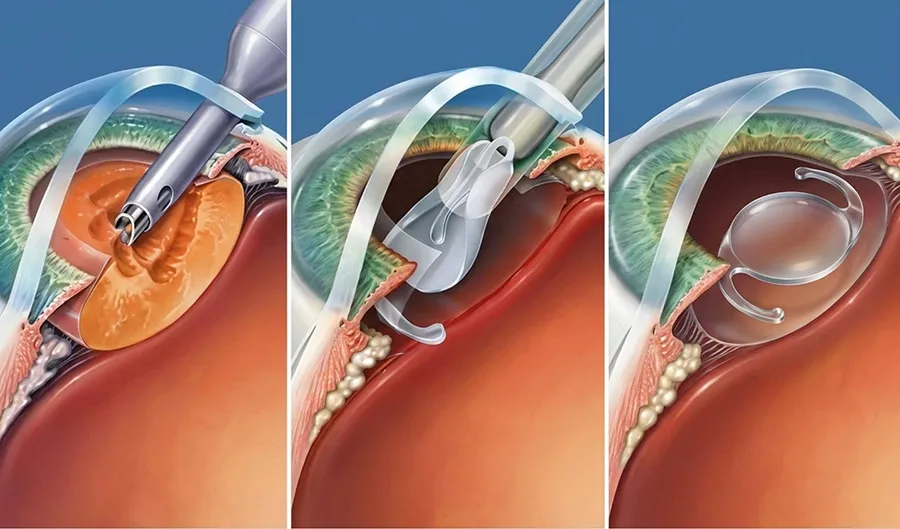
A cataract operation is the same operation everywhere: remove the clouded lens, insert an artificial one. What changes the price is which lens goes in.
| Lens tier | What it gives you | Post-procurement price in China |
|---|---|---|
| Basic monofocal | Clear distance vision; reading glasses for near | About $115–215 [1][3] |
| Premium monofocal (aspheric, extended depth) | Better contrast, some intermediate vision | About $160–500 [1] |
| Toric (astigmatism-correcting) | Distance plus astigmatism correction | Several thousand yuan, tier-dependent |
| Trifocal | Distance, intermediate and near; least dependence on glasses | About $1,270 [1][3] |
So “cataract surgery costs X” is only meaningful if it names the lens. A quote that does not is a marketing figure.
China: what procurement actually changed
In November 2023 the fourth national high-value consumables procurement round opened in Tianjin, covering intraocular lenses and sports-medicine implants. For lenses: average price down 60%, with 126 of 128 bidding companies selected [1].
| Product | Before | After |
|---|---|---|
| Domestic monofocal (highest-volume item) | $360 (2,500 yuan) | About $110 (800 yuan) |
| Imported next-generation monofocal | $1,430 (10,000 yuan) | About $160 (1,100 yuan) |
| Extended-depth-of-focus | $1,570 (11,000 yuan) | About $500 (3,500 yuan) |
| Trifocal (non-toric) | $3,290 (23,000 yuan) | About $1,270 |
Health Times reported a patient who paid $1,040 (7,300 yuan) in total for a single-focus operation in June 2024, of which insurance covered all but $230 (1,600 yuan); the same operation on his other eye in January had cost $1,710 (12,000 yuan) with 3,000 out of pocket [2]. That single case captures the size of the change better than the percentage does.
For a foreign patient paying cash, the relevant figure is the total: roughly $715–1,070 (5,000–$1,070 (7,500 yuan)) for the basic tier at a tertiary public hospital, $1,700–3,570 (12,000–$3,570 (25,000 yuan)) for a premium lens, before any private or international-department premium.
The comparison
| Country | Per eye, standard lens | In USD | How the price is set |
|---|---|---|---|
| China (public) | $715–1,070 (5,000–$1,070 (7,500 yuan)) | 715–1,070 | Regulated service fee plus procured lens [1][2] |
| Turkey | €600–1,200 | 670–1,340 | Private market, often packaged |
| United Kingdom (private) | £2,500–4,000 | 3,140–5,140 | Private market; NHS provision is free but waits [4] |
| Germany | €3,000–5,000 | 3,290–5,570 | Private and statutory mix; premium lenses self-paid |
| United States | $3,000–6,000 | 3,000–6,000 | Insurance and Medicare rates; premium lenses extra |
| Australia | A$3,500–6,000 | 2,290–4,000 | Mixed public and private |
Non-Chinese ranges are indicative private-market figures compiled from published clinic and insurer price lists in 2026, not national statistics. Only the Chinese column can be traced to government documents line by line [1][2][3].
Where the gap comes from
| Factor | Effect |
|---|---|
| Lens procurement | China buys lenses nationally; the same brands cost far more elsewhere [1] |
| Surgical time | Cataract surgery is fast and highly standardised, so the fee is low relative to implants |
| Facility fees | Day-surgery models in China avoid inpatient charges [5] |
| Insurance design | In many countries the basic operation is covered and the premium lens is not, which shifts the visible price |
Five things the price does not tell you
- Biometry quality. Lens power calculation decides whether you end up with the vision you paid for. Ask which device is used and who performs it.
- Femtosecond laser. Often marketed as “bladeless”, it adds cost and is not superior for every eye.
- Second eye. Almost everyone needs both eyes done, weeks apart. The real budget is double.
- Posterior capsule opacification. A common late clouding needing a YAG laser months later. Ask whether that is included and who does it at home.
- Who manages the premium lens if you dislike it. Multifocal lenses cause halos for some patients; exchange is not always straightforward.
One trip, not two
Unlike dental implants, cataract surgery compresses well. The usual travel pattern is: arrive, have biometry and pre-operative checks on day one, operate on day two, review on day three, fly home within a week. The second eye can be done on a later trip or, if scheduling allows, two weeks after the first.
That makes cataract one of the few procedures where the travel cost stays small relative to the treatment. It is also why the comparison is unusually clean: you are comparing an operation, not an episode of care.
City by city inside China
China does not have one price for cataract surgery. Three things differ by province and city.
1. When procurement took effect. The national results were published in November 2023, but each province implemented them on its own timetable — Fujian from 30 April 2024, Shandong issuing its implementation notice in May, several provinces following in June [3]. For a period in 2024, the same lens cost different amounts in different provinces.
2. The service fee schedule. Surgical fees are set at provincial level, so a tertiary hospital in Shanghai and one in Chengdu do not charge identical amounts even for the same operation.
3. Waiting time and hospital type. Big eye centres in Shanghai, Beijing, Guangzhou, Hangzhou and Chengdu run high surgical volumes; a public hospital may book you in days to weeks, while international departments book faster and charge more.
| City | What tends to differ |
|---|---|
| Shanghai | Dense specialist eye centres; international departments with English service; higher private pricing |
| Beijing | National-level eye hospitals; long queues at the most famous names, faster at secondary centres |
| Guangzhou | Strong tertiary eye hospital; large volume, short surgical waits |
| Hangzhou | Provincial capital pricing; good access, less congestion than Shanghai |
| Chengdu | Lower cost base; large referral hospitals serving western China |
The practical advice: ask the hospital in the city you are considering for its own total price for the lens you want, and check which province's fee schedule applies. Do not compare a Shanghai international department with a Chengdu public ward.
The condition in context: what decides a good result
A cataract operation removes a clouded lens and replaces it with an artificial one. The surgery itself is short and highly reproducible; what separates a good result from a disappointing one is usually decided before the patient enters the theatre.
Four things matter. Biometry — measuring the eye's length and curvature to calculate lens power — determines the refractive outcome, and it is operator- and device-dependent. Ocular surface health affects those measurements; a dry eye measured badly produces a lens that is wrong by design. Coexisting disease such as macular degeneration or glaucoma limits how much vision can be recovered, whatever the lens. And lens choice is a trade: multifocal lenses reduce spectacle dependence but cost contrast and can produce halos at night.
That is why a cheap operation with poor biometry is worse value than a slightly dearer one with careful measurement. The question to ask is not only what the operation costs, but who measures the eye and with what.
When not to travel for cataract surgery
| Situation | Why |
|---|---|
| Advanced glaucoma, retinal disease or previous eye surgery | Complex eyes need continuity of care more than they need speed |
| Both eyes needed urgently | Staging and follow-up are easier at home |
| You cannot attend post-operative reviews | Endophthalmitis and pressure spikes are early complications |
| You are chasing a trifocal lens primarily on price | The lens is the expensive part; the saving is smaller than for the basic tier |
Decision checklist
| Question | If yes |
|---|---|
| Do I know which lens tier I am being quoted for? | Comparable |
| Has biometry been done and the lens power calculated? | Ready to book |
| Can I stay 5–7 days for one eye? | Workable |
| Do I have an eye doctor at home for follow-up? | Essential |
| Does the saving exceed travel plus the cost of a repeat trip? | Financially rational |
Availability and limits
- Chinese prices come from procurement documents and a reported patient case [1][2][3].
- Non-Chinese figures are indicative private-market ranges, not official statistics.
- Lens choice changes the price more than the hospital does.
- Outcomes depend on the eye, the biometry and the surgeon, not on the country.
- We are not a provider and do not book treatment.
What to ask before booking
| Question | Why it matters |
|---|---|
| Which lens, by brand and model, and what does it cost separately? | The lens is the variable line [1]. |
| Is the femtosecond laser included, and is it indicated for my eye? | A common upsell. |
| Which department handles foreign patients, and in what language? | We do not book treatment; confirm the international department and its language support. |
| Who treats a complication after I fly home? | Early post-operative problems need urgent local care. |
| Is YAG laser treatment later included? | Posterior capsule opacification is common. |
Questions patients ask
How much is cataract surgery in China?
About 5,000-$1,070 (7,500 yuan) per eye with a basic monofocal lens at a tertiary public hospital, and 12,000-$3,570 (25,000 yuan) with a premium trifocal. The lens, not the surgery, drives the range, and procurement in 2023 cut lens prices by an average of 60% [1][2].
Is cataract surgery in China cheaper than Turkey?
Not necessarily. Turkey's packaged private prices for a standard lens often sit at or below China's public price. China's advantages are a verifiable regulated price, national procurement of branded lenses, and large specialist eye centres for complex eyes.
How many days do I need in China?
Plan five to seven days for one eye: checks on day one, surgery on day two, review on day three, and a buffer before flying. The operation itself takes 15 to 30 minutes.
Does insurance cover the lens?
In China basic lenses are largely covered for insured residents and premium lenses are largely self-paid. For foreign patients paying cash, assume the full price applies [2].
Which city in China is best for cataract surgery?
Shanghai, Beijing, Guangzhou, Hangzhou and Chengdu all have high-volume eye centres. What differs is waiting time, whether an international department exists, and the provincial fee schedule. Ask each hospital for its own total price for the lens you want.