
Quick answer
A brain tumour in a 19-month-old is difficult for three reasons at once: the child is small, the tumour is large relative to the skull, and it bleeds. Add a rare blood type and the operation becomes a logistical problem as much as a surgical one. At Beijing Children's Hospital, Jiang Tao's neurosurgery team removed an 8.7 cm tumour from a toddler with type A Rh-negative blood — after embolising the tumour to reduce bleeding and securing six units of matching blood from the Beijing Red Cross blood bank [1][2][4].
Key takeaways
- Patient: a girl aged 1 year 7 months, with type A Rh-negative ("panda") blood [1][2].
- Symptoms began in January 2026 with repeated vomiting treated as gastroenteritis for two months [1][4].
- Imaging on 20 March showed a huge tumour extending from the frontal lobe to the lateral ventricle and basal ganglia [1][4].
- Surgery took about eight hours, with blood loss far below what the team expected for this tumour [2].
- She was discharged on 10 April and will continue with standard chemotherapy [1][2][5].
Why this case was hard
Jiang described three challenges. First, a 19-month-old has limited physiological reserve, so anaesthesia and haemodynamic support are difficult. Second, the tumour spanned from the frontal lobe into the lateral ventricle and basal ganglia, where complete removal risks hemiplegia and hydrocephalus. Third, it was extremely vascular — he compared it to a sponge full of blood — so any imprecision could cause massive haemorrhage [2][4].
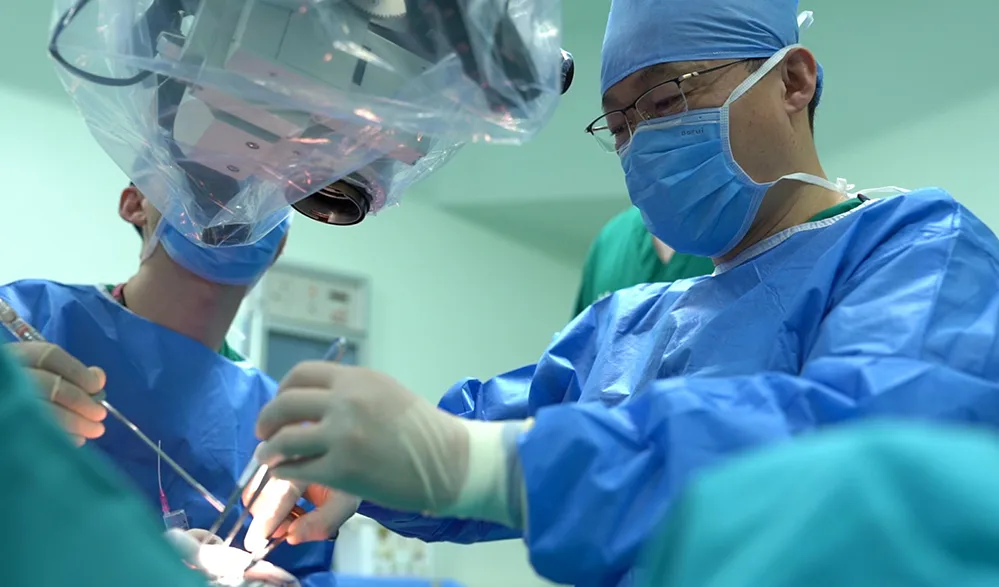
The rare blood type multiplied the third problem: even a well-controlled operation needs matched blood available, and A-negative units are scarce. Several local hospitals had already declined to operate because of the risk [3]. The team's response was to remove the bleeding risk in advance — interventional radiology embolised the tumour's blood supply before surgery — and to remove the supply risk by sourcing blood ahead of time [4].
The plan
A multidisciplinary meeting set the strategy: resect the frontal component first to relieve intracranial pressure, obtain pathology, then treat with chemotherapy rather than attempt a single heroic complete resection. Pre-operatively, Wu Rongchang in imaging performed tumour embolisation, and Ma Shuxuan in the transfusion department worked with the Beijing Red Cross blood bank to secure six units [4].
Single cases like this demonstrate what a national children's centre can coordinate — interventional radiology, transfusion, anaesthesia, neurosurgery and oncology in one pathway — but they are not evidence about outcomes for paediatric brain tumours in general. The tumour type and grade are not specified in the reports, and the chemotherapy plan will determine the long-term prognosis more than the operation did [1][2].
The condition in context: paediatric brain tumours
Brain tumours are the commonest solid tumour of childhood and a leading cause of cancer death in children.
| Region | What the data shows | Source |
|---|---|---|
| Presentation | Vomiting and lethargy are easily attributed to gastrointestinal illness, delaying diagnosis [1]. | Beijing Children's Hospital [1] |
| Surgery | Resection relieves pressure and provides tissue for diagnosis, but vascularity limits what can be removed safely [2]. | Science and Technology Daily [2] |
| Blood supply | Rare blood types add a logistical constraint to any major paediatric resection [4]. | China Medical Information Herald [4] |
Because the symptoms are non-specific, parents and primary care doctors often lose weeks before imaging — which is precisely what happened here [1][4].
Why it matters
| For the patient | What the report suggests | Source |
|---|---|---|
| Bleeding control | Pre-operative embolisation reduced operative blood loss [4]. | [4] |
| Coordination | MDT and prior blood sourcing made the operation feasible [2][4]. | [2][4] |
| Caution | One case; tumour type and long-term outcome not reported [1]. | [1] |
Availability and limits
- This is an editorial summary of hospital and media reports, not a treatment recommendation [1][2].
- It describes one patient, without pathology or follow-up data [1].
- Paediatric neuro-oncology requires a full centre with radiotherapy and chemotherapy [4].
- Rare blood availability is a system constraint, not something a family can arrange alone [4].
- Surgery is one stage; chemotherapy or radiotherapy usually follows [2].
What to ask before booking
| Question | Why it matters |
|---|---|
| Has imaging been done, and how urgently? | Persistent vomiting and lethargy in a toddler warrant imaging [1]. |
| Is blood matched and reserved before surgery? | Rare groups require advance sourcing [4]. |
| Which department handles foreign patients, and in what language? | Beijing Children's Hospital is a working hospital we do not book; confirm international-department coordination and language support. |
| What adjuvant treatment follows resection? | Pathology determines chemotherapy and radiotherapy [2]. |
Questions patients ask
What was the case?
A 19-month-old girl with type A Rh-negative blood and an 8.7 cm intracranial tumour, who had been treated for gastroenteritis for two months before imaging [1][4].
How was the surgery made safer?
The tumour was embolised before surgery to reduce bleeding, and six units of rare blood were secured in advance; the operation took about eight hours [2][4].
Was the tumour completely removed?
The team planned to resect the frontal component to relieve pressure and obtain pathology, then proceed to chemotherapy rather than attempt a single complete resection [4].
How is she now?
She was discharged on 10 April 2026 and will continue with standard chemotherapy [1][2].
Is this relevant to international patients?
It is useful context for China's paediatric neurosurgery. Beijing Children's Hospital is a working hospital we do not book — contact its international department directly [1].