
Quick answer
Mercaptopurine is one of the drugs that keeps children with acute lymphoblastic leukaemia in remission for two years, and its dose is calculated per kilogram and then adjusted to the white cell count. The only tablet available in China is 50 mg, about a centimetre across — an adult dose. More than half of children therefore need a fraction, and parents split tablets by hand or pharmacists cut them with scissors, which does not reliably divide the active ingredient. Beijing Children's Hospital's pharmacy team led development of a 5 mg microtablet, about 2–3 mm across, so that weight-based dosing does not require cutting [1][2][3].
Key takeaways
- Problem: the only domestic mercaptopurine tablet is 50 mg, roughly 1 cm in diameter, designed for adults [3].
- Consequence: over half of children need a divided dose, and manual splitting is imprecise [2][3].
- Solution: a 5 mg microtablet of about 2–3 mm, with a smart dosing system for precise administration [1].
- Development started in 2017 and required new granulation and powder-flow technology [2].
- A technology and clinical trial authorisation transfer agreement for the 5 mg product was signed at the 2022 China International Fair for Trade in Services [1].
Why splitting a tablet is not a trivial problem
A scored tablet splits reasonably; an unscored 50 mg tablet cut into quarters does not, and the active ingredient is not distributed uniformly through the compressed powder. In a drug with a narrow therapeutic index and a dose titrated against blood counts, a sizeable error per dose is clinically meaningful — it can tip a child into over-suppression and infection risk, or under-dosing and relapse risk [2][3].
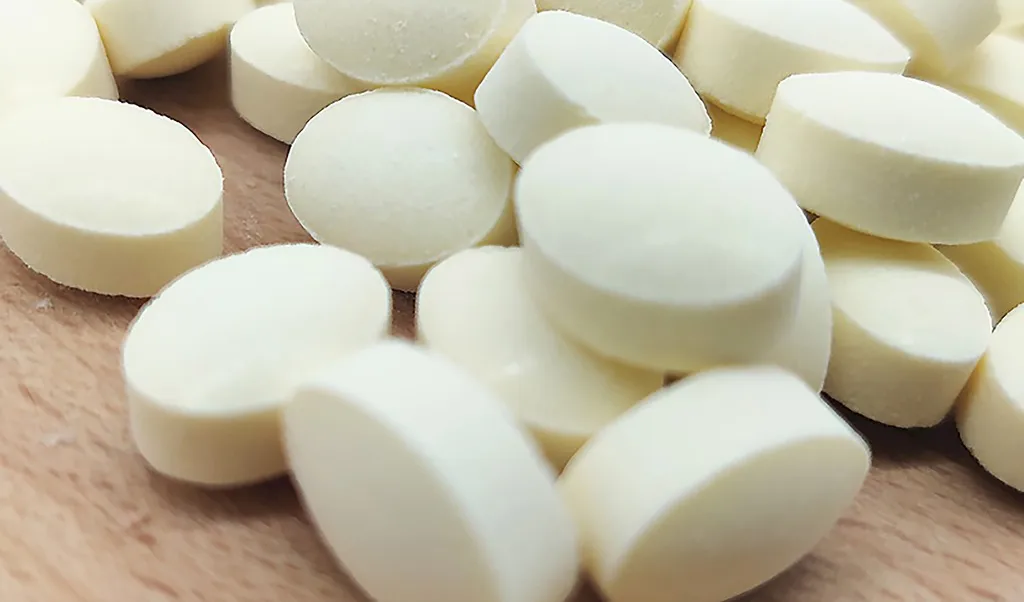
Cutting also exposes staff and caregivers to a cytotoxic drug and produces dust. A small tablet swallowed whole removes both the dosing and the handling problem, and it addresses dysphagia in young children — an under-recognised reason for poor adherence [3][5].
From hospital innovation to licensed medicine
The technical barrier was manufacturing, not pharmacology: making a very small tablet with content uniformity requires different granulation and material-flow control than a standard tablet press. The hospital describes breaking through those formulation engineering problems with an industrial partner [1].
A clinical trial authorisation is not an approval, and the sources reviewed do not describe a completed bioequivalence or pharmacokinetic study in children. A new formulation must show that 5 mg microtablets deliver equivalent exposure to the corresponding fraction of a 50 mg tablet, and that families can actually use them — adherence and dosing-error endpoints matter as much as plasma levels. Price and reimbursement will determine whether it displaces the habit of splitting tablets, which costs nothing at the point of use [1][2].
The condition in context: childhood ALL
Survival has improved dramatically, and much of the remaining mortality now relates to relapse and to treatment toxicity.
| Region | What the data shows | Source |
|---|---|---|
| Role of the drug | Mercaptopurine is a backbone of maintenance therapy and reduces relapse risk [4]. | DXY clinical decision [4] |
| Main toxicity | Myelosuppression; imprecise dosing increases adverse effects or relapse risk [2]. | Xinhua [2] |
| Formulation gap | Children need per-kilogram dosing that changes as they grow, and paediatric forms are scarce [3]. | People's Daily [3] |
| Real-world practice | Maintenance doses such as 7.5 mg are commonly achieved by splitting tablets [5]. | Dosing query record [5] |
Because maintenance lasts two to three years and is taken at home, a formulation that families can dose accurately affects every one of those days [2][4].
Why it matters
| Potential | What the report suggests | Source |
|---|---|---|
| Accuracy | Weight-based dosing without splitting [1][2]. | [1][2] |
| Adherence | Smaller tablets are easier for children to swallow [2]. | [2] |
| Safety | Less cytotoxic dust and hand-cutting [3]. | [3] |
| Caution | Clinical trial authorisation, not approval [1]. | [1] |
Availability and limits
- This is an editorial summary of hospital and press reporting, not a prescribing recommendation [1][2].
- The microtablet is in development; marketing approval is not confirmed [1].
- Bioequivalence data in children are not reported in the sources reviewed [2].
- Cytotoxic handling precautions still apply to any oral mercaptopurine [3].
- Cost and reimbursement are unresolved [1].
What to ask before booking
| Question | Why it matters |
|---|---|
| How is my child's mercaptopurine dose measured? | Hand-splitting introduces error [3]. |
| Is a paediatric formulation available here? | The microtablet remains in development [1]. |
| Which department handles foreign patients, and in what language? | The hospital is a working hospital we do not book; confirm international-department coordination and language support. |
| Who adjusts the dose to the blood count? | Maintenance dosing is titrated continuously [4]. |
Questions patients ask
What is the microtablet?
A 5 mg mercaptopurine tablet about 2–3 mm across, developed so children with leukaemia can receive weight-based doses without splitting adult tablets [1].
Why is the 50 mg tablet a problem?
More than half of children need a fraction of it, and manual splitting does not divide the active ingredient reliably, in a drug where dose precision affects both toxicity and relapse risk [2][3].
Is it available?
Not yet — clinical trial authorisation and technology transfer have been signed, but marketing approval is not confirmed in the sources reviewed [1].
Who developed it?
Beijing Children's Hospital's pharmacy team with an industry partner, starting in 2017 [2].
Is this relevant to international patients?
It is useful context for China's paediatric drug development. The hospital is a working hospital we do not book — contact its international department directly [1].