
Quick answer
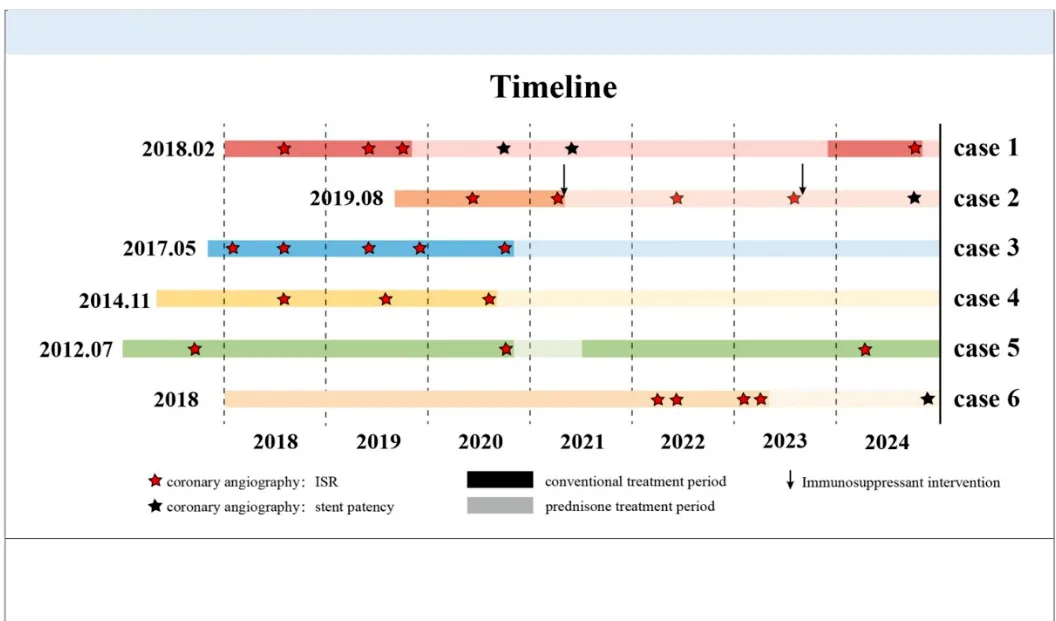
Most in-stent restenosis has an explanation: the stent was undersized, malapposed or fractured, or risk factors were uncontrolled. A minority of patients have none of these and keep re-narrowing the same segment — refractory recurrent in-stent restenosis (RISR), defined as two or more episodes of ≥50% narrowing in the same stent. Qian Haiyan's team at Beijing Anzhen Hospital treated such patients with a low-dose prednisone-based anti-inflammatory regimen and reported a significant reduction in recurrence, published in JACC: Case Reports on 18 March 2026 [1][2].
Key takeaways
- RISR is defined as ≥2 restenosis events of ≥50% diameter stenosis in the same stent segment [1].
- It accounts for roughly 10–20% of all in-stent restenosis cases [1].
- The study was prospective and exploratory, published in JACC: Case Reports [1][2].
- Patients were selected after traditional mechanical and metabolic causes had been excluded [1].
- The regimen centred on low-dose prednisone and significantly reduced recurrence risk [1].
The reasoning
If a stent is well deployed and the patient's blood pressure, lipids and glucose are controlled, restenosis should not recur. When it does, the question becomes whether something outside the lumen is driving it: a persistent local inflammatory or fibrotic process in and around the vessel wall. That hypothesis explains both why repeated mechanical intervention fails and why an anti-inflammatory approach might work [1][2].
The team has pursued the same idea on the diagnostic side: at the European Society of Cardiology congress in 2026 they presented work using 18F-FAPI PET/CT to identify an inflammation-dominant phenotype among RISR patients, with a peripheral blood pattern of high CRP and low monocyte count associating with FAPI uptake. If that phenotype can be identified non-invasively, anti-inflammatory therapy can be targeted rather than given empirically [3][5].
What this study can and cannot show
A prospective exploratory study in a journal built around case reports is designed to generate a signal, not to confirm one. The reported finding — reduced recurrence on low-dose prednisone — is meaningful because the alternative for these patients is an endless cycle of balloon dilatation and repeat stenting [1][2].
Sample size, randomisation and blinding are not described in the available reports, and an open-label steroid study is vulnerable to expectation effects. Low-dose prednisone still carries risks over months: hyperglycaemia, osteoporosis, infection, weight gain. The results justify a randomised trial, not a change in practice — and notably, the diagnostic work to select patients is not yet routine [1][3].
The condition in context: in-stent restenosis
Drug-eluting stents reduced restenosis dramatically, but did not eliminate it, and the refractory subgroup has no good option.
| Region | What the data shows | Source |
|---|---|---|
| Incidence | Restenosis fell from 30–40% with bare metal stents to 5–10% with drug-eluting stents [4]. | Tencent Medical Encyclopedia [4] |
| Refractory subgroup | RISR represents 10–20% of all restenosis and recurs despite optimised intervention [1]. | Yimaitong [1] |
| Consequences | Repeated events raise myocardial infarction and death risk [1]. | Yimaitong [1] |
Because each reintervention carries its own risk and none addresses the underlying process, a medical therapy for this subgroup would fill a genuine gap [1][3].
Why it matters
| Potential | What the report suggests | Source |
|---|---|---|
| New option | A medical strategy where only repeated intervention existed [1]. | [1] |
| Targeting | FAPI PET/CT may identify who responds [3][5]. | [3][5] |
| Caution | Exploratory design; steroid adverse effects [2]. | [2] |
Availability and limits
- This is an editorial summary of the publication, not a treatment recommendation [1][2].
- The study is exploratory; randomisation and sample size are not described [1].
- Low-dose prednisone carries metabolic, bone and infection risks over months [2].
- Selecting the right patients requires inflammatory phenotyping that is not routine [3].
- Mechanical causes must be excluded before considering anti-inflammatory therapy [4].
What to ask before booking
| Question | Why it matters |
|---|---|
| Have mechanical causes been excluded with intravascular imaging? | Undersizing and malapposition must be ruled out first [1]. |
| Is there evidence of local inflammation? | FAPI PET/CT may identify who benefits [3][5]. |
| Which department handles foreign patients, and in what language? | Anzhen is a working hospital we do not book; confirm international-department coordination and language support. |
| What are the risks of months of steroid therapy? | They must be weighed against further reintervention [2]. |
Questions patients ask
What was studied?
A prospective exploratory study of low-dose prednisone-based anti-inflammatory therapy in patients with refractory recurrent in-stent restenosis after exclusion of conventional causes [1].
What did it show?
A significant reduction in restenosis recurrence risk, reported in JACC: Case Reports on 18 March 2026 [1][2].
What is refractory recurrent ISR?
Two or more episodes of ≥50% narrowing within the same stent segment, about 10–20% of all restenosis [1].
Can I be given steroids for this now?
Not on this evidence — the study is exploratory and a randomised trial is needed [2].
Is this relevant to international patients?
It is useful context for China's coronary intervention practice. Anzhen is a working hospital we do not book — contact its international department directly [1].