
Quick answer
Catheter ablation for atrial fibrillation requires a physician to hold a catheter steady against a beating atrial wall for an hour or more, wearing a lead apron and watching fluoroscopy. Both the radiation dose and the hand tremor are limiting factors. On 7 March 2026, Sang Caihua and Huang Lihong at Beijing Anzhen Hospital's arrhythmia centre used the domestic TITIAN electrophysiology robot, with an ultra-high-power ablation catheter, to complete a pulmonary vein isolation in 45 minutes — the first such case after the robot's market approval [1][2][3].
Key takeaways
- TITIAN is described as the first domestically developed electrophysiology robot approved for market in China [1][2].
- Approved by the NMPA on 31 October 2025 through the innovative-device review pathway [5].
- The procedure used a QDOT MICRO ultra-high-power ablation catheter [2].
- Total procedure time from first ablation to leaving the table was 45 minutes [2].
- Anzhen was the principal investigatory site for the pre-approval registration trial from 2023 [1].
What changes when a robot holds the catheter
The system is a master-slave teleoperated platform: the operator sits at a console and drives the catheter through a mechanical arm, which reproduces the motion at sub-millimetre precision and filters out hand tremor. The physician is no longer standing beside the table in a lead apron [2][4][5].
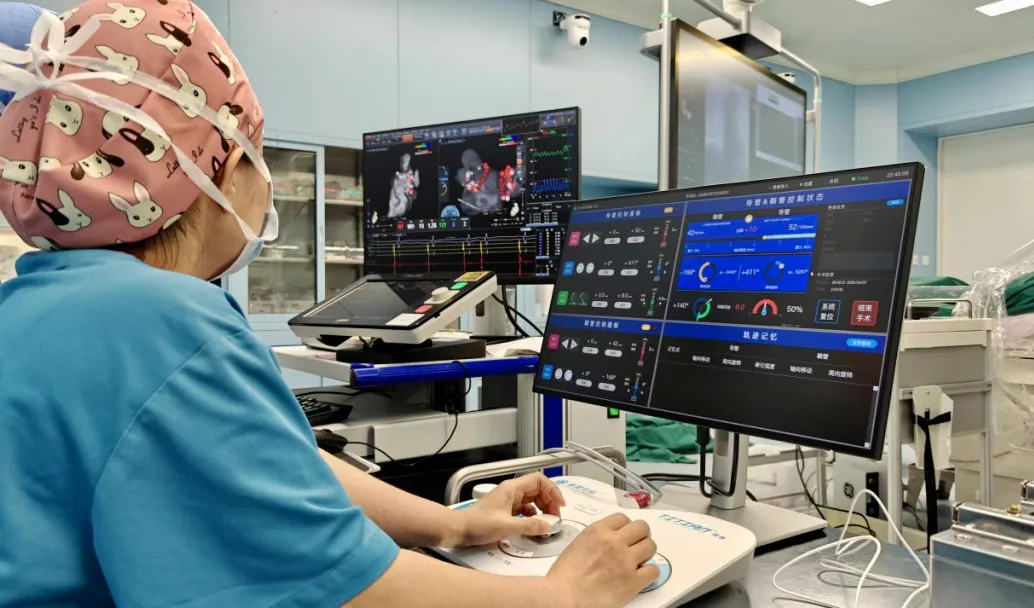
Stable contact matters more with ultra-high-power delivery: at higher power, each lesion forms in seconds, so catheter stability and contact force determine whether the lesion is contiguous and transmural, and whether it is safe. In this case, electrophysiological mapping after ablation confirmed single-shot bidirectional isolation of both pulmonary veins [2].
Where the technology stands
By the end of 2025 the device had been deployed in 36 hospitals, including Anzhen and Sir Run Run Shaw, with more than 40 atrial fibrillation ablations completed. Provincial first cases followed in Jiangxi in April 2026 and Hainan in June 2026. In September 2026 a county hospital in Zhejiang placed the first public commercial order, at 7.21 million yuan [5].
Anzhen's announcement describes a single post-market case demonstrating feasibility with a high-power catheter. It does not report a comparison with manual ablation, fluoroscopy time, complication rates or freedom from arrhythmia at follow-up. Those questions were addressed in the pre-market multicentre trial, but the outcome data are not summarised in the sources reviewed. The most defensible claims here are procedural — precision, operator shielding and speed [1][2].
The condition in context: atrial fibrillation
AF is the commonest sustained arrhythmia, and ablation is the most effective rhythm-control strategy.
| Region | What the data shows | Source |
|---|---|---|
| Procedure burden | Manual ablation exposes operators to prolonged fluoroscopy and requires sustained catheter stability [3]. | Nanchong government [3] |
| Technical goal | Durable pulmonary vein isolation is the core endpoint of AF ablation [2]. | DrVoice [2] |
| Access | Provincial first cases in 2026 indicate diffusion beyond top centres [5]. | Baidu Baike [5] |
Because complex and redo AF ablation is where operator stability matters most, robotics is most likely to earn its place in those cases first [3].
Why it matters
| Potential | What the report suggests | Source |
|---|---|---|
| Occupational safety | The operator works away from scattered radiation [2][5]. | [2][5] |
| Precision | Sub-millimetre catheter control with tremor filtering [2]. | [2] |
| Caution | Single case; no comparative outcomes [1]. | [1] |
Availability and limits
- This is an editorial summary of hospital and industry reporting, not a treatment recommendation [1][2].
- Comparative efficacy and safety data are not summarised in the sources reviewed [1].
- Robotic systems add capital and per-case cost [5].
- Operators need specific training and a learning curve [2].
- Long-term freedom from AF after robotic ablation is not yet reported [3].
What to ask before booking
| Question | Why it matters |
|---|---|
| Is my AF paroxysmal or persistent, and which matters for technique? | Persistent AF often needs more than pulmonary vein isolation [2]. |
| Is the robotic approach being used for outcome reasons or logistics? | The evidence for superiority is not established [1]. |
| Which department handles foreign patients, and in what language? | Anzhen is a working hospital we do not book; confirm international-department coordination and language support. |
| What rhythm follow-up is planned? | Recurrence often appears in the first year [3]. |
Questions patients ask
What was done?
The first post-approval ultra-high-power atrial fibrillation ablation using the domestic TITIAN electrophysiology robot, at Anzhen Hospital's arrhythmia centre on 7 March 2026 [1][2].
How long did it take?
About 45 minutes from the start of ablation to leaving the table [2].
What is TITIAN?
A master-slave teleoperated cardiac electrophysiology robot approved by the NMPA on 31 October 2025, described as the first such domestic device approved in China [1][5].
Is robotic ablation better than manual?
Not established from this case; it shows feasibility, precision and operator shielding [1][2].
Is this relevant to international patients?
It is useful context for China's cardiac devices. Anzhen is a working hospital we do not book — contact its international department directly [1].