
Quick answer
Xiangya Hospital in Changsha led a BMJ network meta-analysis of 189 randomised trials, 12,988 patients and 59 treatments for adhesive capsulitis — the stiff, painful shoulder most people call frozen shoulder [1]. At short-term follow-up, shockwave therapy probably reduced pain by about two points on a 0–10 scale compared with usual care, and manipulation under anaesthesia probably improved forward flexion by 26° on its own, or 33° with an intra-articular steroid [1]. Effects beyond three months and comparative safety remain uncertain, because trials reported harms inconsistently [1].
Key takeaways
- 189 randomised trials, 12,988 patients and 59 interventions — the largest comparison published for this condition [1].
- Shockwave therapy cut short-term pain by 1.97 points on a 0–10 scale versus usual care, at moderate certainty [1].
- Manipulation under anaesthesia added 26.16° of forward flexion; with a steroid injection, 33.29° [1].
- About 71% of trials were at high risk of bias, and most evidence is short-term and drawn from Asia [1].
- There is no single best treatment: invasiveness, cost and patient preference still decide [1].
The condition in context: why 59 options needed a map
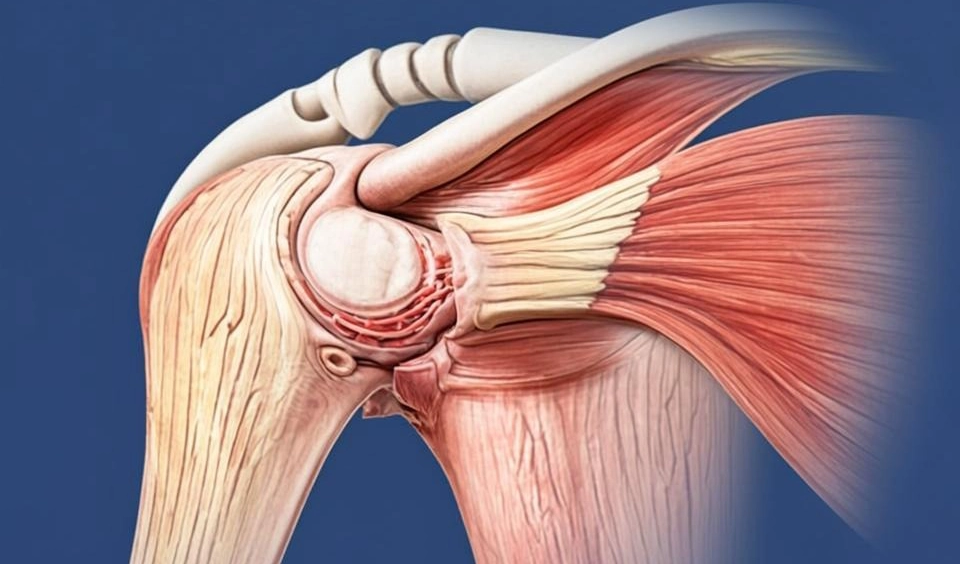
In adhesive capsulitis the lining of the shoulder joint contracts and thickens. The result is not just pain: the arm stops going where it used to, most visibly in rotation and in reaching overhead. It usually appears between 40 and 60, is more common in women, and is associated with diabetes and thyroid disease [4][5].
Clinicians describe it as self-limiting, and often it is — but the discomfort and the lost range can last many months, and the review's own follow-up data stop being informative after the mid-term window [1]. Meanwhile the list of things that can be done is long: steroid injections, hydrodilatation, shockwave, physiotherapy, manipulation under anaesthesia, and surgery. Until now nobody had compared all of them at once, which is why practice varies so much between hospitals.
| Region | What the data shows | Source |
|---|---|---|
| Global | Shoulder pain is common, but published prevalence figures vary widely with case definition and recall period — they are not directly comparable between studies | [3] |
| Diabetes | People with diabetes are more likely to develop frozen shoulder, though the association carries a risk of unmeasured confounding | [4] |
| Korea (3.47 million adults) | Risk rises from prediabetes to type 2 diabetes in a nationwide cohort — the largest single dataset in this field | [5] |
| China | No national registry figure is published; the trials in this review are concentrated in Asia, so Chinese practice has to be inferred from trial settings rather than counted | [1] |
The four rows use different case definitions and different populations. China's absence of a registry number is not a gap in this review — it is a gap in the data, and it is one reason the paper argues for better trials rather than a firm ranking [1][3].
What happened
The team came from the sports medicine unit of Xiangya's department of orthopaedics, led by Gao Shuguang, working with groups in several countries. They followed PRISMA, registered the protocol on PROSPERO, and searched Medline, Cochrane Library, Embase, Web of Science and Scopus to 1 May 2025, with an update in November 2025 [1]. Xiangya is the paper's first and corresponding institution, with Gao Shuguang as corresponding author [2].
The methodological work was not the pooling. It was the separation: 59 interventions were split into nodes, and usual care, placebo and active comparators were kept apart, so that shockwave against sham could be read differently from shockwave against steroid injection [1]. Without that, a network of this size collapses into a meaningless ranking.
Certainty was graded, and the language in the paper follows it. Shockwave probably reduces short-term pain; most other estimates are hedged with may, or reported as very low certainty [1]. Where direct and indirect evidence disagreed — for function and for part of the range-of-motion analysis with shockwave — the authors say so rather than averaging the disagreement away [1].
Pain on a 0–10 scale, function on a 0–100 scale, range of motion in degrees, and adverse events. Short term meant up to three months; mid-term extended beyond that. The headline numbers are mean differences against usual care or against another active treatment, not cure rates [1].
Why it matters
| Question a patient asks | What the review supports | Source |
|---|---|---|
| Will something reduce the pain in the next three months? | Shockwave has the most consistent short-term pain signal: 1.97 points lower than usual care | [1] |
| Will I get my arm up again? | Manipulation under anaesthesia has the clearest flexion gain, 26° alone and 33° with a steroid injection | [1] |
| What about six months or a year? | Not established: mid-term evidence was low or very low certainty | [1] |
| Is it safe? | Cannot be answered from this review: adverse events were reported incompletely, and absence of reports is not absence of harm | [1] |
| Does physiotherapy not work? | Physiotherapy was one of the 59 nodes; the review does not show it failing, it shows the evidence around it is thin | [1] |
That last row is the practical one. A clinic that promises a single answer to a condition with 59 options is not describing this evidence base; a clinic that names the intervention, the dose and the alternative is.
Availability and limits
Shockwave is an outpatient treatment: it needs a machine and a trained operator, not a bed. Manipulation under anaesthesia needs an anaesthetist, a pre-operative assessment and a recovery area, and is normally done where shoulder surgery is also performed. The review does not report which hospitals offer which intervention, and Xiangya has not published a country-by-country availability list, so a specific hospital's practice has to be confirmed directly [1].
The findings do not transfer to shoulder pain with a different cause — a torn rotator cuff, a fracture, an infection, a tumour — because those patients were not the trial population [1]. They also do not answer whether early improvement translates into a better shoulder two years later; the authors explicitly call for head-to-head trials running beyond 12 to 18 months [1].
What to ask before booking
| Question | Why it matters |
|---|---|
| Which of the 59 interventions are you proposing, by name? | "Shoulder treatment" is a category, not a plan |
| Is this shockwave or radial pressure wave, and at what dose and interval? | Energy level, number of sessions and protocol differ, and the review pools by node |
| Who performs the manipulation, and is an anaesthetist present? | It is done under anaesthesia, in a facility equipped for it |
| How many sessions before we judge whether it is working? | The trial outcomes were measured in weeks, not days |
| If it does not work, what is the next step and what does it cost? | Better to know the exit before paying for the entrance |
Questions patients ask
What exactly is frozen shoulder?
The capsule — the tissue envelope around the shoulder joint — becomes inflamed, then thickens and tightens. Pain comes first, stiffness follows, and the usual complaint is being unable to reach a seat belt, a back zip or a shelf. Diabetes is the most consistent risk factor in the literature [4][5].
Does shockwave therapy really work?
For short-term pain, the evidence is the strongest in the review: 1.97 points lower than usual care on a 0–10 scale, at moderate certainty, with a confidence interval that excludes no effect [1]. For function the certainty drops to low, and the direct and indirect estimates disagreed, so it is reasonable to expect some benefit and unreasonable to expect a cure [1].
Is manipulation under anaesthesia dangerous?
The review supports the range-of-motion benefit at moderate certainty, but it cannot quantify harm: adverse events were reported incompletely across trials, and the authors warn against reading silence as safety [1]. In practice the questions to ask are who performs it, in what facility, and what happens if the shoulder does not move afterwards.
Can I have this done in China as a visitor?
Shockwave is delivered in outpatient departments; manipulation requires anaesthesia and a pre-operative assessment, so it is planned rather than walk-in. Which department leads depends on the hospital — orthopaedics, sports medicine or rehabilitation — and this review does not list providers [1]. We publish hospital context and can check what a named department offers; we do not book or perform treatment.